

A Summer Romance Improved My Sense of Well-Being
On self-concept, tenderness, and the lie that needing other people is a weakness.

Healthy Futures is free to read and always will be. Paid subscribers get Wellness Debrief, The Shelf, and a few paid essays per month. If you’re not ready for that but want to support the work, you can also leave a tip via PayPal. Now, let’s get into it.
It was 90 degrees outside, and I was incredibly late. My first attempt at doing my makeup was a major fail. My foundation oxidized on me, and I ended up looking like an Oompa Loompa if it had black hair and a nose ring. Redoing it took longer than expected, and I anxiously texted my date to let them know I’d be late—how late, I didn’t know, but at least 15 minutes.
I walked into the bar an unknown amount of time later, but the cool air was almost as refreshing as his demeanor. He really wasn’t bothered that I was late, and he was still happy to meet me and get to know me. After a trip to the bathroom to blot the sweat off my face and make sure I wasn’t musty—listen, D.C. gets humid in the summer and that moisture sticks to you—I was glad I’d shown up.
Yes, I considered canceling even though he was already waiting for me at the bar.
Conversation felt effortless, and when the servers mistakenly brought a free birthday treat to our table, we both leaned into pretending it was actually my birthday. Drinks were the pregame to the concert he’d invited me to after learning that I enjoyed seeing indie artists on the verge of blowing up, and that, generally, I loved music, and I was willing to listen to any genre. During the middle of the set, I realized I’d never put on the necklace I’d brought with me. I asked him if he could, since my nails were too long and the lights were too low for me to fumble with it. Feeling his fingers touch my neck sent a knowing jolt down my spine, as if I’d swallowed a firecracker. The night wrapped up with a kiss, or 20, and so began a wonderful thing.
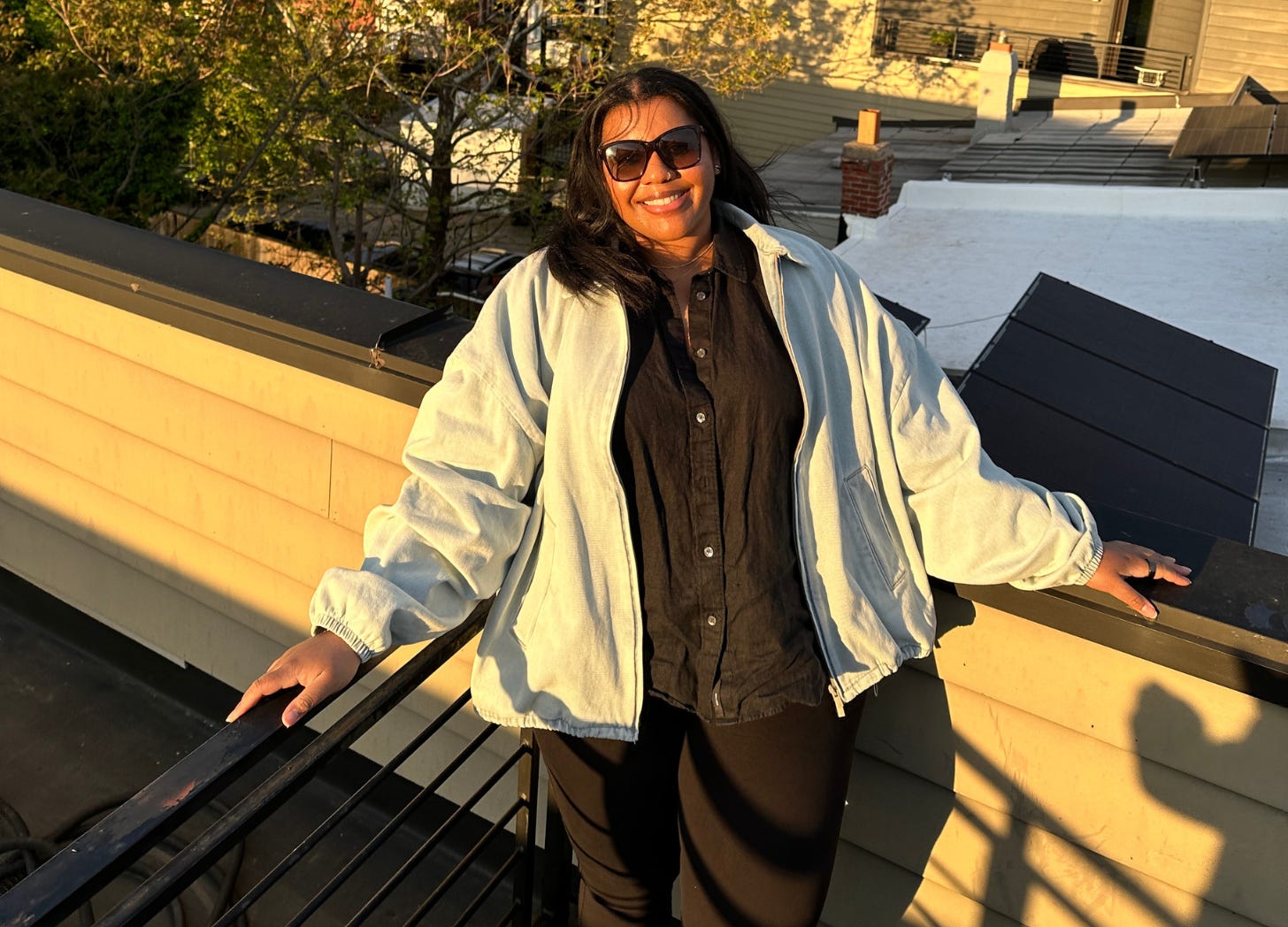
We spent late summer and the fall roaming our way through the city—spending nights in bars, playing mini-golf, going ax-throwing, and talking a lot. I enjoyed his company, and I enjoyed being understood and accepted. I didn’t have to mask around him. Our thing ended before the year did, sitting on my rooftop, watching the sunset. He removed my shades and said, “I want to look at you.”
Indeed, I’d never been looked at like that before. He saw me the way you approach the sociopolitical complexities present between the brush strokes of a Basquiat or the way you angle your head to get a better sense of whether the Mona Lisa is indeed smiling at you. Curiously. In a way comparable to seeing a baby laugh for the first time, at what you don’t know, but it kicks up a sense of wonder we lose as we age, and become entrenched in the mundane, and the muck of responsibility that comes with it.
Experiencing romance in this way reshaped how I saw myself. Respect and understanding are complex neurobiological processes, as far as how we, as complicated beings, land on what deserves our neural energy, but the effects they have on us are pretty straightforward. We feel less lonely, more empowered, and validated in who we are. I started holding my head higher. I laughed louder. I felt like I had permission to be myself after leaving a relationship where every choice I made was an audition to keep my role in my ex-boyfriend’s life. In our current social ecosystem—which includes IRL and online communities—finding validation outside of yourself is depicted as a weakness, despite it being a normal part of human behavior and socialization. It’s important to reach inward for tenacity, self-worth, and self-concept. I’ll never argue with that, but people don’t exist in silos; we live in community with each other. How can we be totally individualistic? How can we find everything we need in ourselves? We can’t even find everything we need in one other person! How are we not supposed to care what other people think, especially when we care about them? How are we not supposed to consider those opinions as we create ourselves? It doesn’t make sense, and I’m not interested in continuing to conflate a desire to be seen with dependency on external validation.
Ever since that summer, I’ve been enthralled with how to bring seeing someone without flinching into other areas of my life. I believe it can be done through tenderness. As my dear friend Maya Cade said in 2023: “Tenderness is spent moments of affection, whether familial, romantic, or among confidants. Tenderness can show up as a warm embrace, a gesture of understanding, whether that’s a head nod or a glance that you get from your family when you’re across the room and they just understand. I think that can be a tender moment. Tenderness is warmth, understanding. Of course, love is a part of it, but it’s not all of it.”
A frame of tenderness holds space for the fact that me and him weren’t in love with one another. When romance is identified as the vehicle for radical transformation, it’s often reduced to nothing more than fervent passion or promoted as love when it’s not—but tenderness can hold the weight of any connection. A tender bond won’t demand a performance; it just asks you to show up because that is enough. Tenderness, in practice, looks like the people by whom I’m surrounded pouring into me when my sense of self runs dry. It also looks like me doing the same for them when, inevitably, they experience drought. It’s the willingness to see someone without flinching and remain in community with them.

I think about him removing my sunglasses on the roof more than I should.
I want to look at you.
I look the same as I always do.
I wish I could remember what he said about me against the backdrop of the sunset.
I’m sure it was beautiful.
I’m sure it was tender.
Everything you just read is free, and I want it to stay that way! But the work behind Healthy Futures isn’t. If this issue earned your trust, a tip or a paid subscription helps me keep earning it.