

The MAHA Matrix: Mapping the Self-Improvement-to-Conservatism Pipeline
An interactive framework that plots wellness and other sociopolitical trends by ideology, aspiration, and scientific evidence.

Healthy Futures is free to read and always will be. Paid subscribers get Wellness Debrief, The Shelf (launching soon), and a few paid essays per month. If you’re not ready for that but want to support the work, you can also leave a tip via PayPal. Now, let’s get into it.
You’ve seen the trajectory. Someone gets a gym membership, starts a few supplements, and maybe listens to the Huberman Lab podcast. They drop some body fat and get better sleep—no big deal. But for a sliver of those people, it goes further: skepticism about seed oils is first, then beef tallow on the skin instead of a moisturizer, then raw milk, then a full embrace of a broader conservative politic, which is now codified in federal policy due to MAHA.
Many of us have spent years watching this happen online or IRL. At some point, a person who just wanted to be healthier begins parroting talking points from a deregulatory political project with ties to white nationalism.
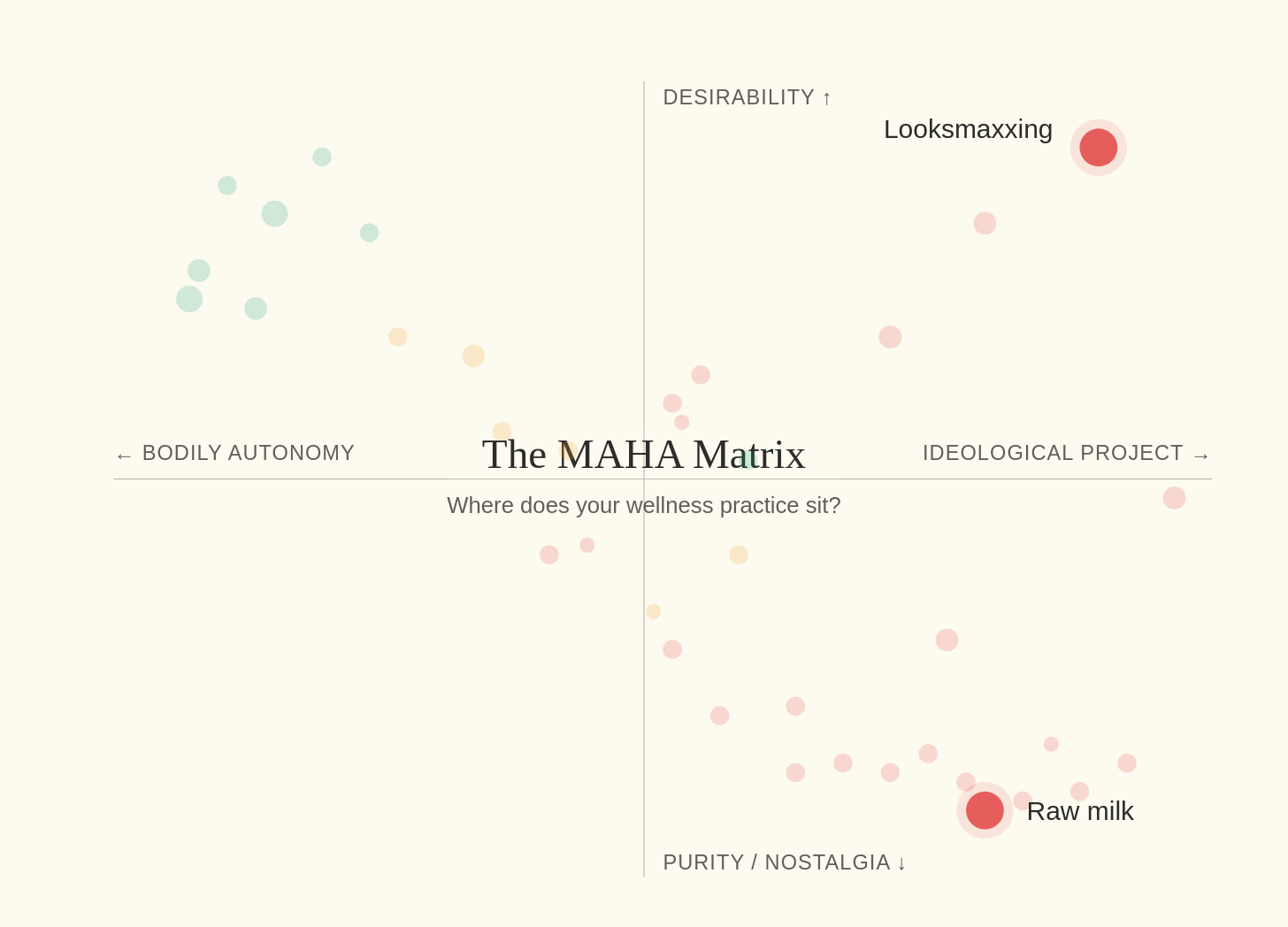
This has been percolating in my head for a while now, so I built what I’m calling The MAHA Matrix: an interactive scatter plot that visualizes the line between normal self-improvement practices and conservatism. The result is a visualization of how capital and ideology move people from “I just want to look and feel better” to “processed foods are poisoning you,” and how the evidence thins out as the journey becomes more extreme.
The matrix maps a system, not individuals, running through content creation, consumer products, and policy infrastructure.
Well, this embed is interactive for anyone reading in the Substack App or on a web browser. Hover over a point to briefly learn more. Click on it to view any sourcing.
What The Axes Mean
The X-axis runs from bodily autonomy to ideological project. The former refers to “decisions about your own body,” such as getting a gym membership, getting lip filler, and weight training. On the right, you have things like MAHA policy, looksmaxxing, the anti-vax movement, and the manosphere—ideological projects that require you to adopt a worldview to participate. These go beyond buying a product or service; you’re being recruited into a belief system that has a specific political valence.
The Y-axis runs from desirability at the top to purity and nostalgia at the bottom. Desirability is longing aimed forward. It’s aspirational. You want to look good, feel strong, be attractive, and perform well. It’s fairly honest about what it is.
Purity and nostalgia is longing aimed backward. It’s the fantasy of life before whatever modernity you’ve been taught to fear. It manifests as consumer behavior and belief, but the engine underneath is always a lie about the past in service of a present political project.
Why I’m Highlighting Evidence
Every item on the matrix is color-coded by the strength of its evidence base:
Green items are supported by decades of research and clinical data. Yellow means that real studies exist, but the claims made for these inclusions in the wellness/self-improvement ecosystem far exceed what the research shows.
Red is where the chart gets crowded. These practices and movements are either unsupported or actively contradicted by the available science.
The pattern that emerges is stark, making the pipeline quite visible. Evidence thins as you move right and down. Almost everything green sits on the bodily autonomy side of the chart, while everything red clusters toward ideological project and purity/nostalgia.
The Most Interesting Thing
It was shocking to see that the bottom-left quadrant ended up being almost completely empty. The MAHA matrix shows that you cannot exercise bodily autonomy within a framework of purity and nostalgia because these are ideologies.
Bodily autonomy can realistically be paired with desirability. Here are some examples of decisions a person makes about their own body that do not require conservative ideology as a foundation:
“I want to look a certain way, so I’m getting this procedure.”
“I want to be stronger, so I’m lifting weights.”
“I want clear skin, so I’m using retinoids.”
And some that operate within a framework of conservatism:
“I drink raw milk because I don’t trust what’s in pasteurized milk.”
“Vaccines cause autism.”
Purity and nostalgia require a theory of contamination: the belief that something, someone, or, in the most extreme instances, a group of people is a corrupting force. The “us versus them” dichotomy, hidden beneath sometimes benign language, is what makes the pipeline seen in the matrix so effective. It doesn’t announce itself, and each step feels like a personal choice.
The MAHA Matrix is my attempt to make that pipeline visible in a single image because the first step to not getting played is seeing the game.
Everything you just read is free, and I want it to stay that way! But the research behind Healthy Futures—the clinical reviews, the sourcing, and the hours spent making sure every claim holds up—isn’t. If this issue earned your trust, a tip or a paid subscription helps me keep earning it.