

I Can't Make Tyra Banks the Face of What the 2000s Did to Us
Netflix's Reality Check brought America's Next Top Model back into the conversation. But the story is bigger than the show— and Tyra Banks.

Content Warning: This essay discusses body dysmorphia, disordered eating, and bulimia.
On New Year’s Eve 2003, as millions watched the ball drop in Times Square, I stood in my room, measuring tape in hand. I looped it around my waist and scribbled down the measurement before moving on to my hips and each thigh. My goal by New Year’s Eve the following year was to have a 24-inch waist, 34-inch hips, and thighs that didn’t touch.
I was 11 years old.
The 2000s were a difficult time for anyone who had a body and whose brain was still developing—especially so if you were a girl, a teenager, or a young woman. This verity has returned to the forefront of my mind following the release of Reality Check: Inside America’s Next Top Model. The Netflix docuseries gave former contestants and judges space to talk about what actually happened on set. The detailed accounts of racism, exploitation, and a sexual assault caught on film have, rightfully, called into question the show’s legacy and that of its creator: Tyra Banks.
I came of age during the 2000s. I turned eight at the beginning of the millennium, and by the end of it, I was 18. My prepubescent brain absorbed the ridiculous beauty standards of the era, like a sponge soaking up dirty dishwater, during the hours I spent immersed in women’s magazines and tabloids, and adolescent Julia acted on the resulting desires. I didn’t eat much and, when I did, I would binge and purge using laxatives—a form of bulimia that often goes unrecognized and undiagnosed, as it did in me. I did this for years, working around whatever limitations I encountered to keep the cycle going.
Regardless of that … I guess I’ll call it an effort, I’ve always been thicker. Genetics plays a significant role in that. My baby fat stuck around until puberty, when my hips started spreading. Being curvy wasn’t accepted, and I thought I was fat. Few women sported curvy bodies, and the ones who did caught hell for it. Despite the snide remarks, Mo’Nique proudly embraced her size. Countess Vaughn, who starred on Moesha and The Parkers, was the butt of endless fat jokes on the former and even from her own costar, Brandy IRL. Raven-Symoné was told she was “too big” to be a performer. And Beyoncé navigated disordered eating publicly for years—up until she said she was finally done with it following her Coachella performance prep.
Then, of course, there was Tyra.
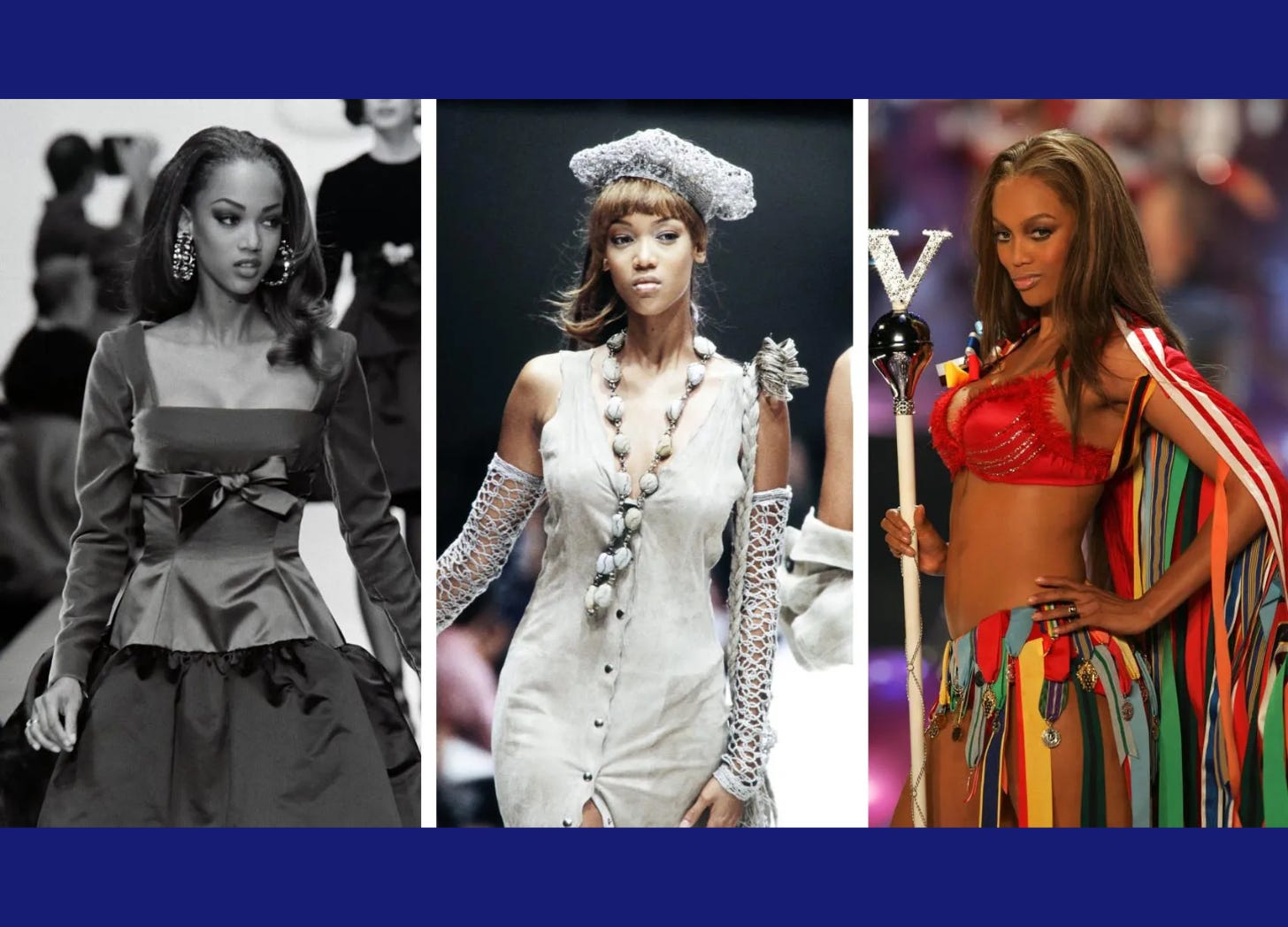
Her contributions to the world of body acceptance shouldn’t be undervalued, but neither should they be exaggerated. Banks has always been forthcoming about the fucked up things people said about her body, often to her face, during her modeling career and after. One time, Italian agents gave her mother a list of designers who didn’t want to work with her because she was “getting thicker.” Banks not only talked about this, but she refused to take it on the chin. Perhaps the most clear example of this is her infamous monologue on The Tyra Banks Show. In 2007, after unflattering paparazzi photos were used to body shame the former supermodel in tabloids, on celeb gossip sites, and the internet writ large, Banks issued a brash PSA, wearing the same swimsuit from the photos.
I have something to say to all of you that have something nasty to say about me or other women who are built like me ... women whose names you know, women whose names you don’t, women who’ve been picked on, women whose husbands put them down, women at work or girls in school—I have one thing to say to you: kiss my fat ass!
The moment was met with raucous applause in the studio and around the world. It became a paean to women worldwide who felt unfairly admonished by thinness—including me. The monologue seemed to fit with the broader body positive ethos Banks projected. On ANTM, Banks selected contestants who defied the industry’s narrow standards in some way—dark skinned Black women, Latina women, Asian women, women who weren’t the sample size, women with visible imperfections—and promised that she could make them into boundary breaking stars. It was a commitment that drew many of us to the show.
It was devastating to see gimmicky, abject cruelty play out. It’s equally gut-wrenching to have not realized it at the time, and enjoyed the show. But, unlike Banks, I was a child.
Banks grown ass told fatphobes and misogynists to kiss her fat ass while she humiliated contestants on camera. ANTM’s design was synonymous with the media and modeling industry’s bottom line: make the contestants fit the beauty standard, treat them terribly if they don’t to keep the ratings up, or do both. Every episode was tailored to that mission—through makeovers, weigh-ins, inappropriate and racist photo shoots, go sees, and eliminations that punished the people and bodies the show and its creator claimed to celebrate. In the docuseries, she takes no accountability for it, which elicited jaw drop after jaw drop. It was nasty work.
Still, I can’t make her the face of the early aughts’ sour disposition or the moral failings of the modeling industry.
Too many responses to Reality Check are failing—or refusing—to look at the broader systemic context that allows for shows like ANTM to exist. As my good friend Taryn Finley wrote for Refinery29:
ANTM wasn’t just a look into the exploitative extremes models experienced behind the scenes. It held a mirror up to the homogenous beauty standards that Americans celebrated in the early to mid aughts. The message was resounding: thin and white was right. And if you were a woman of color, you better adapt quickly if you want to get anywhere.
Banks wasn’t the direct cause of my bulimia; that was a combination of absorbing harmful beauty standards and not having the framework to understand what was happening to me, which is due, in part, to no one looking for it in someone who looks like me and no one raising awareness for girls who look like me. She didn’t create these conditions, but she did perpetuate them while positioning herself as their challenger. After painting herself as a vanguard of body acceptance, she took young women who dreamed of a career in modeling—many of them women of color fleeing poverty—and promised to give them that career while preserving what made them unique. She failed to do so and, instead, misled the public and the contestants, then exploited that dishonesty for further profit.
Tyra Banks sold millions of women snake oil, and for that, she must be held accountable.

I stopped binging and purging in my early 20s. I wish I could say it was a conscious act of liberation, that some afternoon I decided the number on the scale or my pants size no longer had jurisdiction over me. It wasn’t. I was in therapy at the time and, in a moment of radical honesty, I told him what I was doing. It was less like a fog lifting, and more like speeding out the other side of a thick haze, only to realize you’re about to drive off a bridge. The fog the 2000s laid down was thick and purposeful, constructed by systems far larger than any one woman or any one show.
To keep with the mirror theme, the one ANTM held up reflects more than one face. In it, I see the magazines I hoarded as a tween and the newer editions currently stacked in my living room. I see the tabloids that circled parts of women’s bodies in red and TikTok comments with thousands of likes, calling women fat if they don’t have a flat stomach or saying “it’s a sign” when they ask for a seatbelt extender. I see the industry that built the stage Banks performed on, and the culture that bought every ticket. And we were all, in some way, complicit in demanding the show go on.
Banks was both an architect and a product of a cruel system. But if Reality Check only gives us a villain, we’ve missed the point. The system doesn’t need a face. It never did. That’s how it distracts us. That’s how it survives.
The 2000s didn’t just give us bad television. It gave us a measurable body image crisis. An analytical look at the data on what the 2000s did to Black girls—including eating disorder rates, diagnostic gaps, and the role of media in worsening it—is below. Paid subscribers get the research underneath this edition of Microdose. Considering switching over for less than an oat milk latte at your favorite coffee shop.
