

Voting Rights Are a Determinant of Black Health
The recent Supreme Court ruling is about more than political power.

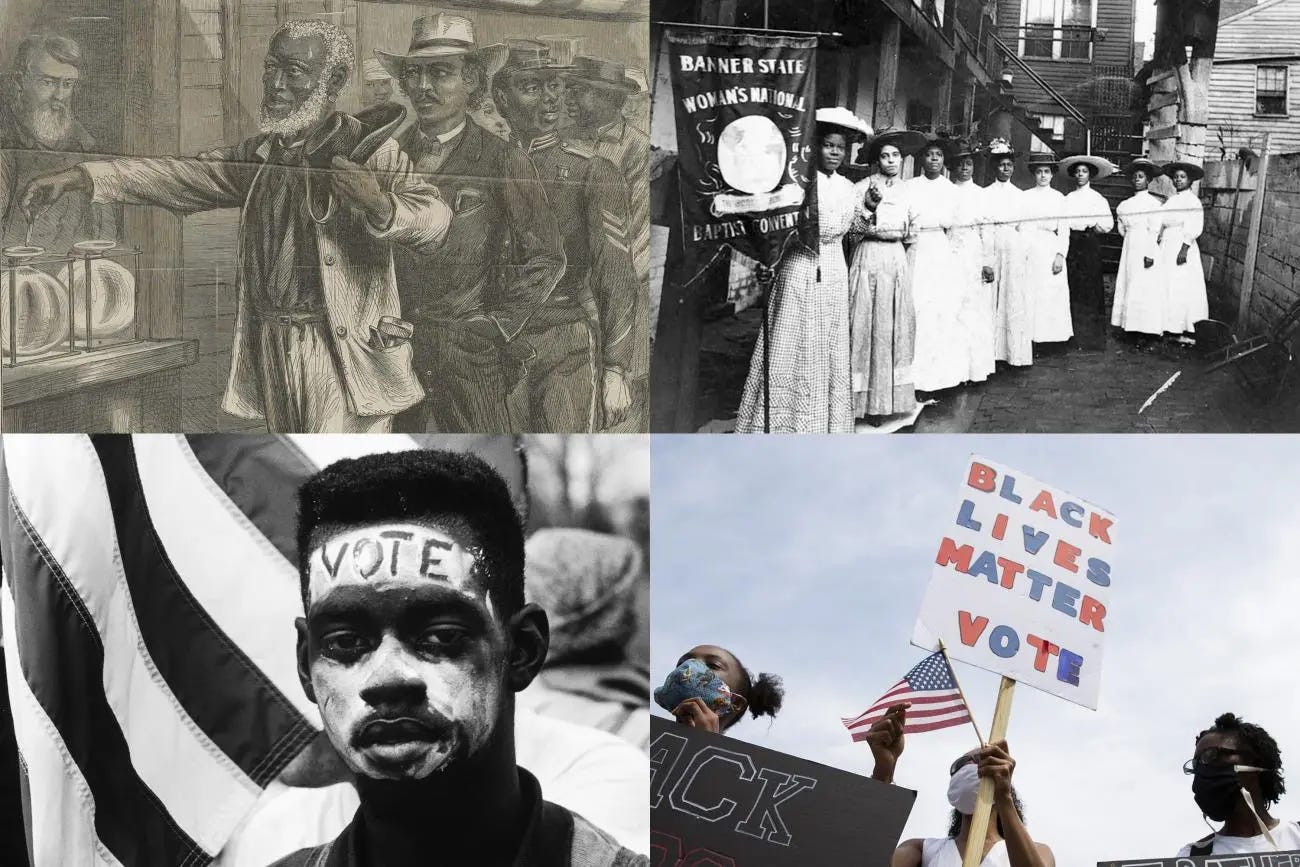
On April 29, the Supreme Court undermined a key provision of the Voting Rights Act. The vote in Louisiana v. Callais came down along the party line, and the ruling will result in election districts throughout the South redrawing their maps to reduce the power of the Black electorate, meaning there will be fewer Democratic candidates and people of color being elected into office. I believe Richard L. Hasen summed up the implications of this best in his piece for Slate:
Louisiana v. Callais will go down in history as one of the most pernicious and damaging Supreme Court decisions of the past century. All six Republican-appointed justices on the court signed onto Justice Samuel Alito’s opinion gutting what remained of the Voting Rights Act protections for minority voters, while pretending they were merely making technical tweaks to the act.
This decision will bleach the halls of Congress, state legislatures, and local bodies like city councils, by ending the protections of Section 2 of the act, which had provided a pathway to assure that voters of color would have some rudimentary fair representation. It’s the culmination of the life’s work of Chief Justice John Roberts and Samuel Alito, who have shown persistent resistance to the idea of the United States as a multiracial democracy, and a brazen willingness to reject Congress’ judgment that fair representation for minority voters sometimes requires race-conscious legislation. It gives the green light to further partisan gerrymandering. It protects Alito’s core constituency: aggrieved white Republican voters. It’s a disaster for American democracy.
Healthy Futures is free to read and always will be. Paid subscribers get Wellness Debrief, The Shelf, and a few paid essays per month. If you’re not ready for that but want to support the work, you can also leave a tip via PayPal.
There is a lot of informative writing about the long-term political implications of this, so I will focus on what this means for the health and well-being of Black folks going forward. Voter suppression is a structural form of discrimination, and like every other form, it makes people less healthy. When you can’t vote, you have less say in the political decisions that shape the conditions of your life—meaning you lack power when choices are made about Medicaid, hospital funding, data center locations, environmental protections, housing, maternal health, and other facets of public health.
A few research points to back up this correlation:
The VRA, in its first five years, prevented roughly 6,700 Black babies from dying before their first birthday in the counties where federal voting protections kicked in hardest.1
People who live in areas with restrictive voting measures are more likely to self-report having a lower quality of health, and this association is stronger for Black Americans, even after controls for individual behaviors are considered.2
Felony disenfranchisement laws, which are grounded in white supremacy and have a legacy of targeting Black voters, negatively affect the health of Black people.3
Harvard researchers found that Black infant death rates were higher in Jim Crow states than in those without the policies from 1960 to 1964. The rate had shrunk by 1970–1974, with convergence occurring between 1965 and 1969, immediately following the passage of the VRA and the Civil Rights Act.4
A companion study found that being born in a Jim Crow state is associated with increased odds of estrogen-receptor-negative breast tumors among Black women, with the effect only found in women born before 1965. ER-negative tumors are more aggressive and harder to treat, meaning the political geography of someone’s birth is detectable in their tumor biology decades later.5 Even though these studies don’t isolate voting rights, they provide evidence that civil rights protections, of which voting rights were a central part, function as health interventions.
I’m particularly concerned about how this plays out at the state and local levels. Even though statewide elections—like for governor, attorney general, or ballot initiatives—can’t be technically gerrymandered since the state votes as one constituency, state legislative districts can be. The Callais ruling will allow those legislatures to redraw their maps to lock in supermajorities that will then set the rules governing every statewide election. That’s the mechanism by which the ruling cascades down ballot and ultimately into micro-level health policy decisions.
We’ve seen time and time again that if a community doesn’t have a say in policy, it won’t have a fair chance at being healthy. Sadly, this is another moment that, a decade from now, will have more data points to add to this ledger.
Tamara Rushovich et al., “1965 US Voting Rights Act Impact on Black and Black Versus White Infant Death Rates in Jim Crow States, 1959–1980 and 2017–2021,” American Journal of Public Health 114, no. 3 (2024): 300–308, https://doi.org/10.2105/AJPH.2023.307518.
Scot Schraufnagel et al., Restrictive State Electoral Environments and the Health of Black Americans, (2025), https://doi.org/10.1111/ssqu.70077.
Patricia A. Homan and Tyson H. Brown, “Sick And Tired Of Being Excluded: Structural Racism In Disenfranchisement As A Threat To Population Health Equity,” Health Affairs 41, no. 2 (2022): 219–27, https://doi.org/10.1377/hlthaff.2021.01414.
Nancy Krieger et al., “The Unique Impact of Abolition of Jim Crow Laws on Reducing Inequities in Infant Death Rates and Implications for Choice of Comparison Groups in Analyzing Societal Determinants of Health,” American Journal of Public Health 103, no. 12 (2013): 2234–44, https://doi.org/10.2105/AJPH.2013.301350.
Nancy Krieger et al., “Jim Crow and Estrogen-Receptor-Negative Breast Cancer: US-Born Black and White Non-Hispanic Women, 1992-2012,” Cancer Causes & Control: CCC 28, no. 1 (2017): 49–59, https://doi.org/10.1007/s10552-016-0834-2.
Kind of a stretch. Would require an experimental or quasi-experimental analysis to prove the claim.
Plus a white man has represented the black folks of my hometown of Memphis since 2010. Now the likely winner of TN-9th will be a black republican woman. They say this is racist, but I do not see it, and I am black.
All the SCOTUS ruling says is that states cannot redistrict by skin color.
https://torrancestephensphd.substack.com/p/democrats-and-the-tennesssee-two