

Dr. Omolara Thomas On Why A Healthy Future Starts In Communities
"It starts with us pouring funds into making sure everyone is fed, housed, has access to basic income, and is employed. That’s what's going to bring health," she said.

If you find value in this work, consider subscribing or upgrading to a paid subscription to support more of it. Your support helps keep this going and makes a real difference. Thank you for being here.
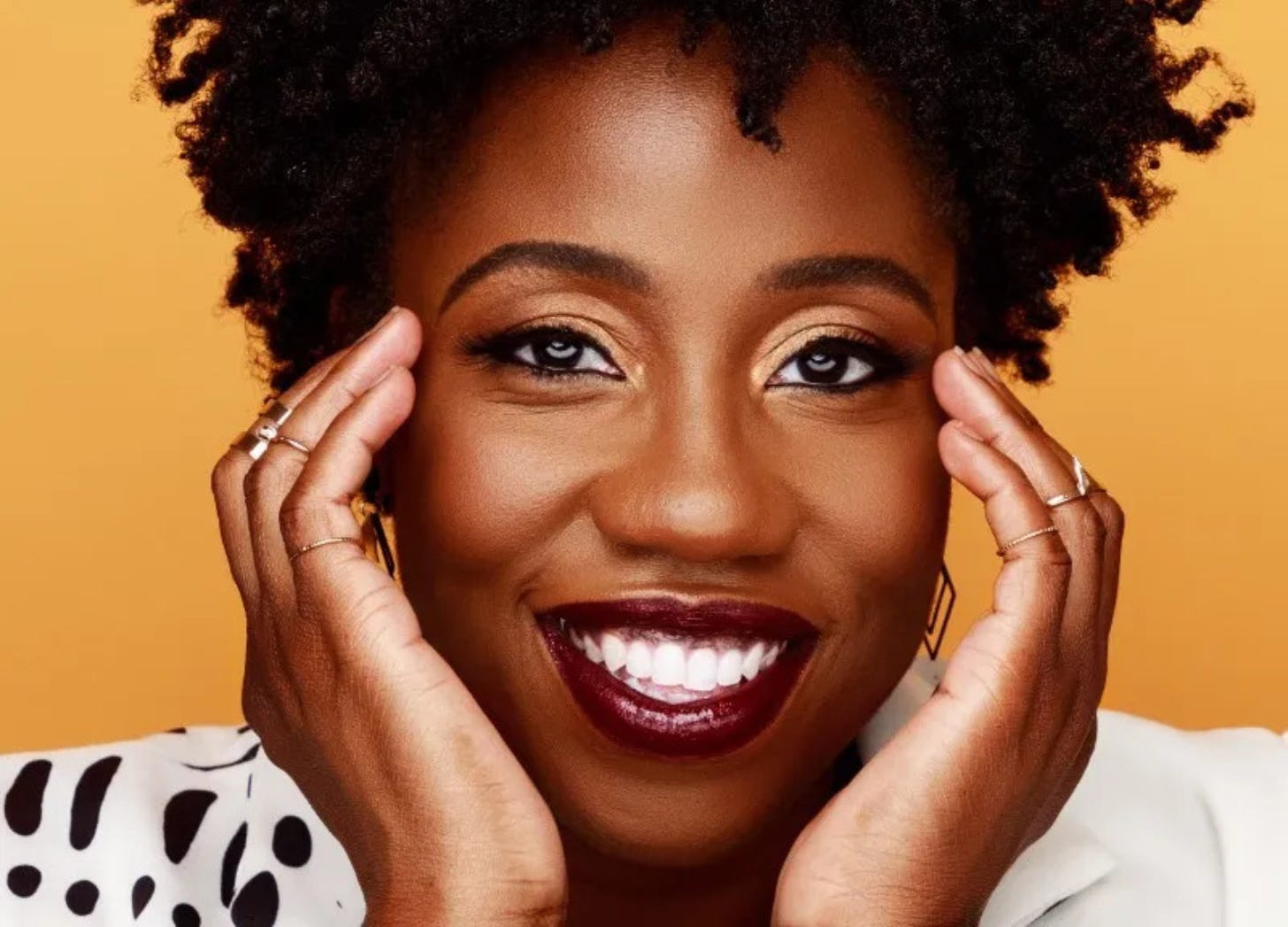
When Dr. Omolara Thomas said, “A healthy future starts in communities,” she spoke directly to the soul of this newsletter. Too often, we consume ourselves with individual health and wellness pursuits—we spend hundreds of dollars on skincare products or isolate ourselves from the collective, usually as an attempt to take care of ourselves when the news becomes too challenging to navigate. We’d better serve ourselves and our communities if we took that impulse to go inward and funneled it back into our communities. (I’m talking to myself right now because I’m a bit too good at disappearing into Sephora to buy things I don’t need just to shake off a bad news cycle.)
My conversation with Dr. Thomas began as an excavation of the impact that primary care physician (PCP) shortages will have on Black communities. These shortages are a growing concern, characterized by the increasing scarcity of accessible doctors and healthcare professionals who provide general medical care. The issue is exacerbated by several factors, including an aging population that necessitates more care, a shortage of medical graduates entering primary care fields, and high rates of burnout and retirement among current providers. Of course, we can’t forget that the year after the Supreme Court’s 2023 decision eliminating race-conscious affirmative action in higher education, fewer applicants from underrepresented racial and ethnic groups got into U.S. medical schools.
But our discussion then evolved into a nuanced conversation about the need for innovative partnerships and funding models to support comprehensive, community-based medical care that addresses medical and social needs. Otherwise, we risk creating a two-tiered healthcare system where specific populations are entirely shut out from access to basic services that improve their health and well-being.
Dr. Thomas has been a pediatrician for 21 years. She’s the co-founder and CEO of Strong Children Wellness, an award-winning, Black woman-owned, advanced primary care practice network delivering integrated primary care, mental health, and social care services to children and families in under-resourced communities of color. Our conversation has been edited for length and clarity.

Julia Craven: I’m slowly shifting gears to make this my first question instead of the last. What does a healthy future look like to you?
I have this idea in my head of all of us working collaboratively in a place-based system. For example, even if I'm in a medical practice, I’m connected to the food pantry, which is connected to the housing people and the employment center, and we’re not working in silos. We’re able to actually communicate with each other, so at every entryway, there is a point where we can get someone what they need.
A healthy future is about the nonclinical things. I know this sounds weird coming from a physician, but I'm the weakest link. Clinical care only contributes to 20 percent of health outcomes, and 80 percent is contributed by where we work, live, play, our access to food, and other social determinants of health. A healthy future starts in communities, not clinics. It starts with us pouring funds into making sure everyone is fed, housed, has access to basic income, and is employed. That’s what's going to bring health, rather than the medicines that I'm able to provide or the clinic visit. I still think we're helpful, but I'd say all that would be more helpful.
Hard agree. That takes us right into PCP shortages. That's a significant concern that disproportionately affects marginalized communities, who already face structural barriers to care. For Black communities specifically, what does this look like?
There's no good way to put this. If we have fewer doctors, we will have less high-quality care. Doctors will have to move through patients faster—and we're already moving fast with 15 minutes per patient—and the quality of care likely will suffer. PCPs are the gateway into the rest of the system: so, for example, certain physical exam findings might get missed if someone doesn’t have a PCP or if their PCP stops practicing. Then someone who needed to go to an oncologist is not referred to the oncologist. And the ramifications of that are very clear.
For Black populations in particular, the presence of Black PCPs in a community has a measurable impact on health outcomes. One study found that even without a direct patient-provider relationship, simply living in a county with a higher proportion of Black PCPs was associated with increased life expectancy and lower mortality rates for Black residents. It's pretty important for us to be there. But PCPs are also the least likely to get a huge salary. That's important because Black physicians often have higher amounts of debt because they don't have as many resources to help pay for their medical education. Ultimately, you'll see more Black individuals moving towards subspecialties that assure they will have a salary that lets them pay off their debt.
That creates a maldistribution of Black practitioners. We have a lot of studies that talk about the fact that when there are nonconcordant physician patient relationships we see detriments in the quality of care. It has huge ramifications for us.
Now I'm wondering about companies like One Medical that create barriers to access because they actually do pay primary care physicians pretty well. Both of my Black PCPs were through One Medical, but the company only takes certain types of insurances—the ones you find out are $800 or $900 a month once you get your COBRA paperwork—and then there's a membership fee plus any copays. If you can't afford those extra layers to get to the Black PCP, who is just trying to make a living and pay off their own debt, then *shrugs*. What context does that provide to the shortages, and how communities that need access to Black PCPs aren’t invested in?
A few things. One, we have to recognize that this model is extremely broken in terms of the idea that people can only get access to high-quality care if they are rich or have a substantial amount of resources. If they don't, then they're going to get the bare minimum of care. And now you can't even get the bare minimum of care because Medicaid is going to be cut. Black people disproportionately live in poverty1, so we are going to be in this space that will have a higher percentage of us experiencing a loss of our health insurance coverage, making it really difficult for us to find potential PCPs in general, regardless of whether they are Black or not.
The other piece of this is thinking about ways to get Black PCPs into under-resourced communities. We still have some programs that provide loan payments if someone works in an under-resourced community. Getting more funding into those kinds of programs could be very helpful.
It also has to do with how Medicaid is reimbursed and being able to increase those payments. That's the only way we as a practice have been able to do quite well, given our patient population. We had to tap into really interesting models to help us take care of these patients, because otherwise, many practices don't participate because Medicaid pays so low. A lot of the policy work has to start from the ground up, which is getting better reimbursements for Medicaid, which I know right now is not really on the table at this point, given the cuts.
I hear on the ground quite often that this entire system is kind of awful across the board. Patients and advocates are rightfully upset that doctors don't take Medicaid. When I talk to doctors, many of them would love to, but it's too complicated, the reimbursements are too low, etc. You said your practice tapped into new ways to ensure patient care. What models exist outside of the current one?
It depends on your state, but what you’re looking for are programs that offer what's called a per-member-per-month payment model. Instead of only being reimbursed for each patient visit, this model pays a fixed monthly amount for each patient under your care. The idea is that you're being compensated not just for in-person visits, but for the full spectrum of care you provide—like preventing hospitalizations, following up with patients, managing prescriptions, and coordinating other services. It recognizes the ongoing work that happens outside of the exam room. We call this value-based payment, which is basically the value of providing more care. Health Homes, a federal program some states have decided to implement, includes intensive care management. Another one is called Collaborative Care, which includes working with patients who have mental health disorders.
Unfortunately, a lot of times these programs are primarily for patients who have additional psychosocial complexity and are more likely to be hospitalized because of that. So they're saying, we'll give you a certain amount each month for that patient because we know if you provide this care, they won't go into an expensive hospitalization. For many programs, you have to have a certain type of practice to take care of those patients. So, a lot of practices don't participate because you'll need behavioral health workers, case managers, and other professionals to participate.
Sometimes, independent provider associations exist for practices that participate in Medicaid. Instead of going to Medicaid with just your practice, they pool the number of lives2 between multiple practices and negotiate for those member-per-month rates rather than getting a fee per service.
Explain a little bit more about psychosocial complexity.
I like to use medical complexity as a parallel. A lot of people understand that if there's somebody who is well, and then there's somebody who may have multiple chronic conditions and has to go to different doctors to get that resolved. That's somebody who is non-complex versus somebody who's complex. So psychosocial has those two components of psychological issues and then social issues.
For the psychological issues, we're looking at patients who might have a higher level of either anxiety or depression, or they may be exposed to that by a family member or household member, or they may have other psychological conditions. The social complexity is that they have some adversity affecting how they live, work, play, eat, or grow. That can be a number of things, from housing to childcare, access to employment, access to food, to the education of parents, and even to the health or food deserts in their neighborhood. What we know is that about 14 million children in the U.S. have special healthcare needs, which is one thing, but about a third of those are actually psychosocially complex. Half of the practices that care for these children don't have any resources to support them.
Thank you for that. It seems like the only people who benefit are private insurance companies here.
That sounds about right. What we're entering is going to be like the pre-Affordable Care Act, but worse. Pre-ACA, we saw that people didn't have access, and the ERs were horrible. It's just going to be worse than that. Private insurance companies won't be affected by this. There'll be little effect for them.
I think about the lack of resources for families a lot because it comes up all the time during my work, and it's really disappointing. How are you thinking about this current moment, considering that we're in a position where families are being set up to have even fewer resources available to them?
It has kept me up at night for months now. About 80 percent of the families we serve are covered by Medicaid. So ultimately we serve a population that is predominantly low income, predominantly Black and Brown, and heavily immigrant. These are all of the people who disproportionately are going to be affected by the cuts in the “Big, Beautiful Bill.”

What we're going to need to do is create some really innovative partnerships, and that's what we have done outside of the healthcare sector, so that families will be able to go, let's say, to the healthcare institution and still be able to be connected to housing or food through streamlined referrals. We will need to really consolidate our communication and our partnerships so that it's easier for families to get access to the things they can still have access to. And then trying to see if we can also think about how to engage philanthropy to really make sure that these specific types of programs, maybe not for everyone, but for the families that are going to be truly cut out of care, that we can solicit funding to be able to support those specific types of programs and populations.
So it's a really hard place because federally qualified health centers (FQHCs)3 and places that are safety net hospitals are also being attacked in terms of how much funding they're going to be able to get to take care of this larger population that is probably going to go into their spaces.
When you were talking just now, I thought about how a common retort to governmental funding cuts is, “Well, what about charity? What about philanthropy?” But many people don’t understand just how much of the bill the federal government foots for these programs—and that doesn’t negate that they should be allocating even more than they already do. You can't rely only on philanthropy when millions of people need healthcare or childcare. What are the fallouts of these massive cuts and the belief that benevolent rich people will just fill in the gaps?
The benefits that are going to be cut are $1 trillion. Philanthropy can do its best, but it's not going to fill that gap. What can be really helpful is thinking about those who are the most shut out of everything. So, for example, undocumented immigrants will pay completely for this, unfortunately, in terms of the lack of access, because there won't be any other way that they can get into healthcare without there being some kind of charity care program.
Of course, we'd like to ensure that every group has access, but some groups will be completely eliminated from the board. Can we at least target funds—if we're getting external funding—to ensure that those particular populations who are completely shut out have some access?
What is being propagated is this two-tier system of individuals, and particularly when we talk about kids, you think about the long-term effects of that. This system will leave us with two types of Americans: one who is healthy and getting care, and one who is not, and maybe not even getting access to other critical services. Those who have access to a healthier life are not going to come out unscathed because resources will need to be intermingled to make sure that the population without access is being provided for. How will that affect the adult population in the next 20 or 30 years?
It means overburdened ERs and longer wait times. It means now an ear infection gets foregone, and now a child actually has to be hospitalized emergently because they have this huge infection. That hospital bed has now been taken, which it shouldn't have been, because that person should have been able to just go to their primary care doctor and get that ear infection resolved, rather than the ER.
A lot of the discourse here is that if you're healthy, you won't need all of this care. Or if you work harder, you won't be poor and you won't need Medicaid. Whenever you're doing the work that you do, how do you think about and consider these lies and the systems they uphold? I guess it’s more PC to call them narratives, but the idea that individualism, grit, hard work, and doing what you're supposed to do will prevent you from being in any type of bad health or financial situation is a lie.
I like to always remind people that we live in a country where all our institutions are collective, meaning, for example, a hospital must take care of whoever comes through the door. Let’s say you break your leg. Now, because those physicians are taking care of an onslaught of people who are in the ER rather than going to see a PCP, you have to wait hours longer to get your foot fixed. Ultimately, what happens to others—especially within hospitals, within schools—will affect you. I just try to remind people that you can try to isolate yourself from this, but it will always come back to affect you.
It's always going to come back to us.
Just to be super clear here: Black people disproportionately experience poverty, meaning the poverty rate is higher relative to the population size. However, because the white population is larger, the total number of white individuals in poverty remains greater.
“Number of lives" refers to the number of individual patients (or members) covered under a healthcare plan.
Federally Qualified Health Centers (FQHCs) receive federal funding from the Health Resources and Services Administration (HRSA) to provide primary care services in underserved areas, ensuring access to essential healthcare for all—regardless of their income, insurance status, or immigration status.