

Holding Space with SisterSong
Monica Simpson, SisterSong’s executive director, and Dr. Noelle Spencer, the organization’s research manager, on how space-making is a form of care for Black folks.

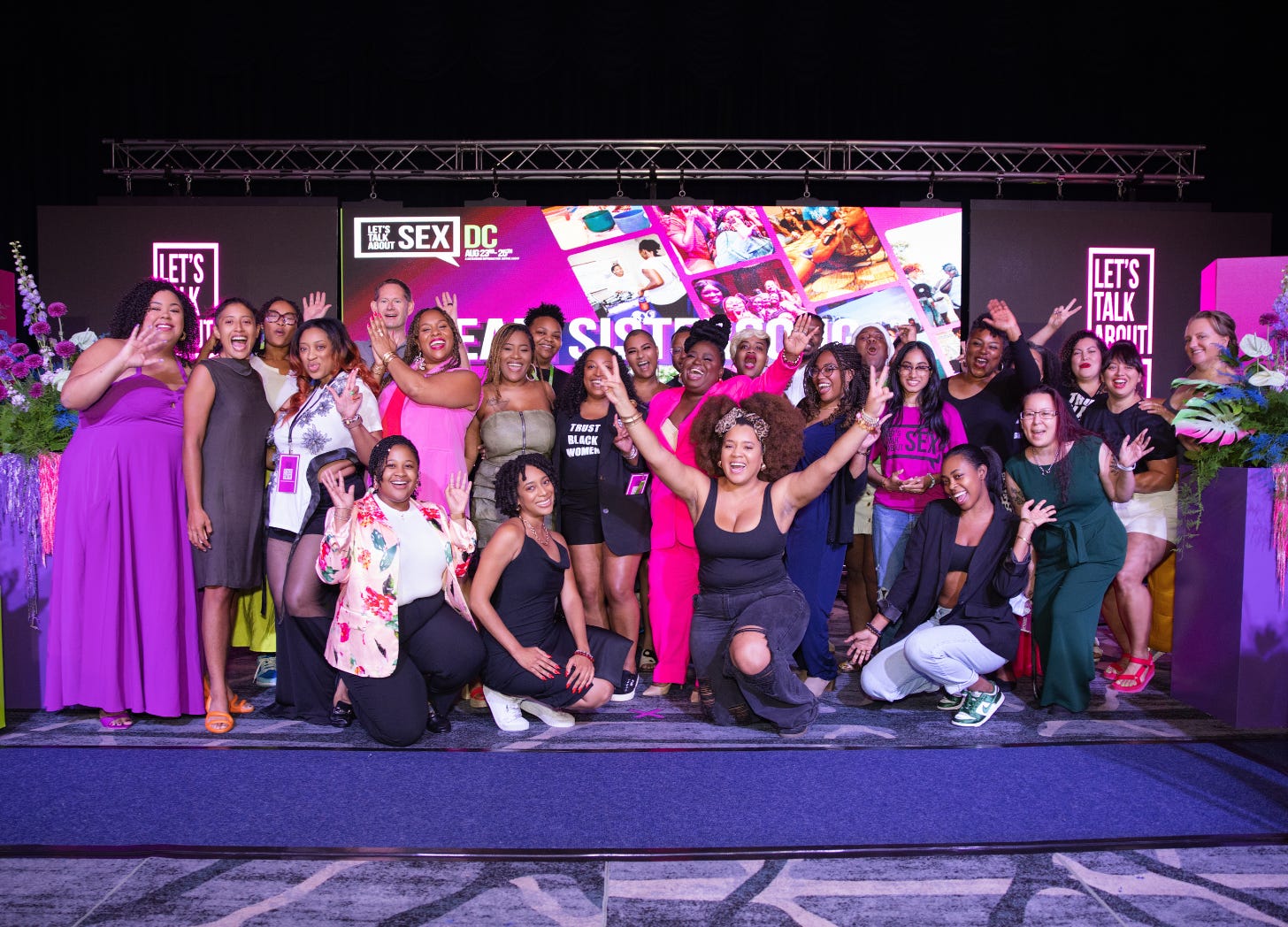
Throughout my career, I’ve been drawn to the idea of creating space for Black people to exist, talk, and share their stories without having to contextualize everything or make it relevant to the current media cycle. This pull for space to breathe and vent freely is what drew me to SisterSong, a legendary reproductive justice collective for people of color, and their powerful approach to community-based research and organizing.
Recently, I had the opportunity to speak with Monica Simpson, SisterSong’s executive director, and Dr. Noelle Spencer, the organization’s research manager, about how they foster cathartic conversation and how that space-making becomes a form of revolutionary care.
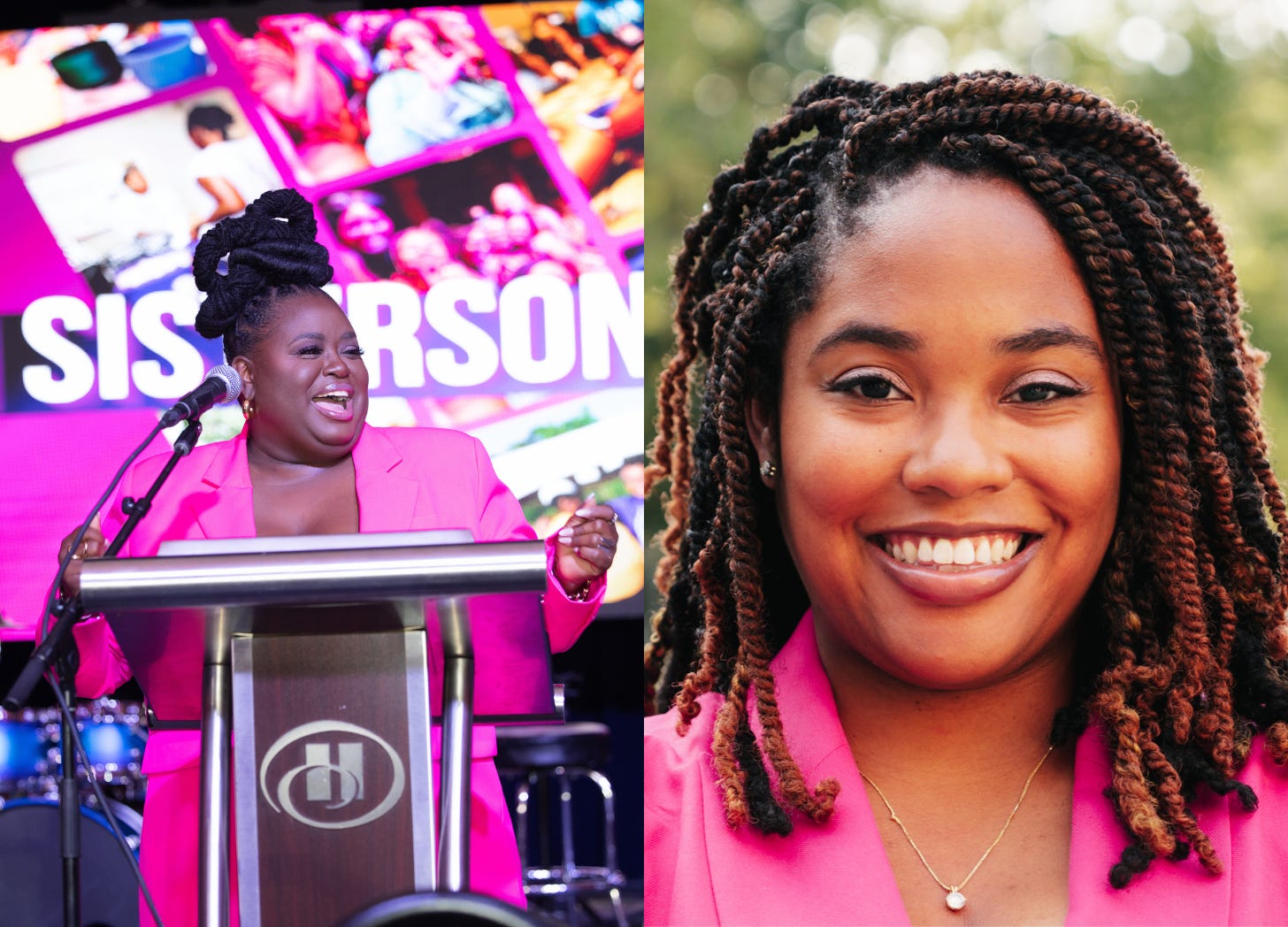
A bit of background: Simpson has been Sister Song’s Executive Director since 2013 and has been with the organization for 15 years. Her journey to reproductive justice began with questions she had growing up in rural North Carolina about why Black women couldn’t speak in church pulpits and why schools weren’t talking honestly about sex when “most of the women and young girls that were going to church with me were pregnant before they graduated high school.”
After doing organizing work around LGBTQ liberation, civil rights, and prison abolition, Simpson discovered reproductive justice in 2007 when she heard Loretta Ross, the former executive director of SisterSong and one of the organization’s co-founders, speak. “It was the first time that I felt all of my identities come together, and I didn’t feel like I had to compartmentalize a part of myself,” she said.
Dr. Spencer brings a background in public health and sexual and reproductive health to her role. Much of SisterSong’s current research portfolio “focuses on the family planning space, contraception, abortion, and speaking to folks who are multiply marginalized about the impact of policy on their lives.” Her thoughtful research design processes help the organization make people feel seen and heard.
Below is our conversation, edited for length and clarity.

Julia Craven: For anyone who hasn’t followed SisterSong’s journey, how would you describe what the organization does?
Monica Simpson: SisterSong was founded in 1997 through the merger of 16 organizations that belonged to four mini-communities.1 In 1997, the large white mainstream organizations were the ones leading the reproductive rights strategies and leading the narratives. What these Black women and women of color understood at that time was that their stories were unique, their experiences were unique. The way that oppression showed up in their lives was very different than those who had the privilege to make a choice.
SisterSong was created to be an organization that allowed the experiences and the expertise of women of color and Black women to move to the center of this conversation. It was created to bring the term reproductive justice, which was created in 1994, to life in terms of theory and practice. We wanted to organize using a framework that was more intersectional, rooted in human rights, and informed by Black feminist theory and thought, at a time when much of that was not visible in the movement.
SisterSong has always been about building institutions, creating leaders across the BIPOC communities to advocate for humans to have the children that we want in the ways that we want, or to prevent pregnancies without shame, and to parent our children in healthy and safe environments. This framework has grown to be even more inclusive of LGBTQIA+ liberation.
The goal of our work is to create an environment where BIPOC communities can see themselves reflected, their stories reflected and amplified in a way that moves them towards action. It really is about creating opportunities for our stories to be amplified in a way that gives people the opportunity to see and understand their power and move towards action. Would you add anything to that, Noelle?
Dr. Noelle Spencer: You’ve covered really the crux of it, and I’m always in awe of hearing you speak about the past and future of this organization. As somebody who is still rather new, it has been really powerful to see how much of a trusted partner SisterSong is to so many different groups of folks across the country.2 One of the gifts of the work that I’m able to do at the organization is travel across parts of the South to speak to folks in their communities. And something that has continued to bowl me over, especially someone who came out of academia, is how much people trust SisterSong just on name alone because of the work that the organization has been doing for so long.
Being here has also meant thinking about what duty of care looks like to our members and, really, to everyone who interacts with us in the work. That has a large impact, given the very real harms that communities have seen research do in the past. It really reaffirms our commitment to community-based participatory work, whether that is research programming or any other way that we interact with individuals. That has been such a powerful thing for me to see, that people trust the work that we’re doing because of the work that we’ve done and the relationships that we’ve formed.
I’m really, really interested in how you two take care of yourselves. Managing all of the work that you do in service of community, I’m curious to know how you’re taking care of yourself so that you don’t burn out?
Simpson: Maybe three years ago now, at this point, I had a moment of extreme burnout. My body was just like I am done with you. I really thought I had it together up until that point. I got massages. I go to therapy. I did the things. I didn’t realize what I was holding in my body until I needed to do a complete reset on my entire system. SisterSong was staffing up at that time. We were bringing on all these new people, and I could barely take a 20-minute meeting without feeling anxious. It was a very, very scary time for a person who was used to their brain moving the way that it needed to.
It forced me to rethink what it means to really take care of myself. I had to change my diet. I had to change the way that I took care of my body, and I had to engage a wellness team. I realized I could not do it by myself. Now I have a team of folks who are supporting me with my working out, with my nutrition, and they hold me accountable. That has been a game-changer for me. It was really about me creating a team and returning to the things that feed me—my music, my art, my culture, and my work. That is what feeds me every single day. If I’m not incorporating some level of music and creativity in how I’m doing my work, then that is weighing on my spirit.
Dr. Spencer: Returning to the things that bring me joy and really trying to focus on the positive, not in a toxic positivity way, but in an expansive abundance mindset way, has been incredibly helpful. So has relying on my support network, my friends, and the people who are excited about this journey. That’s what keeps me grounded and capable. And of course, exercise, trying to eat well as much as possible, those sorts of things.
We’re having this conversation because I was drawn to the work that y’all did with Ibis Reproductive Health, the Trust Black Women Partnership. What I loved about it is that you did what political problem solvers, as I like to call them, rarely do. You went into the community, and you gave people space to tell their stories. What is the power of Black people narrating their own experiences, especially during politically volatile moments? Though I’m not sure if any one moment is more politically volatile for us than any other.
Simpson: Our approach to research, in particular, has always been about the community-based participatory research process because we are an organization that is committed to seeing and understanding our stories as sacred and as our organizing power. When you give Black people the opportunity to share their stories in these moments that are so volatile, it gives people power. Our stories give us power when we’re able to be heard, when we are able to see ourselves reflected in other people, because we are sharing these stories amongst folks who look like us. So we don’t seem like we’re alone anymore. ‘I don’t feel like I have to hide because I can now see myself reflected in somebody else.’ That is power. And in a world that is committed to diminishing and abolishing our power, we have to find the places where we can get it back; it’s through our stories.
The work we did with Ibis, we’ve done this process multiple times in research spaces. In 2014, we did work around maternal mortality that helped to launch a broader conversation in this country around Black maternal mortality and what was happening there. It also helped to birth organizations like Black Mamas Matter. Bringing Black women together in the South to tell their stories led to that level of change and impact. The same thing happened around our Trust Black Women study. It was an opportunity for us to ask the questions that we rarely get to discuss publicly—or even in safe environments—and to find community with people who are dealing with the same issues or have similar stories to ours.
Those conversations helped us produce a piece of work that helps people see and understand what Black women and Black trans women are holding and dealing with. And this helps us develop organizing strategies to address those gaps.
Dr. Spencer: The community-based participatory research that we practice in large part is also community building. That has been so incredibly powerful to see, especially those moments where you realize that the space—perhaps a focus group, perhaps an interview—that you are curating with a person might be that first time that they’re able to have these conversations. But sometimes, we have some very emotionally charged interactions, not in a negative way, but it can almost be a cathartic experience for some of the folks who agree to participate in our research.
This might be their opportunity to stand in front of members of their community and say, “XYZ has happened to me. I need these things for my community.” Even if that doesn’t materialize immediately, being able to put that ask out there is important. Of course, we hope that what we do will be able to impact things on a larger scale, but what has been really incredible to see is how impactful it has been at the neighborhood level as well.
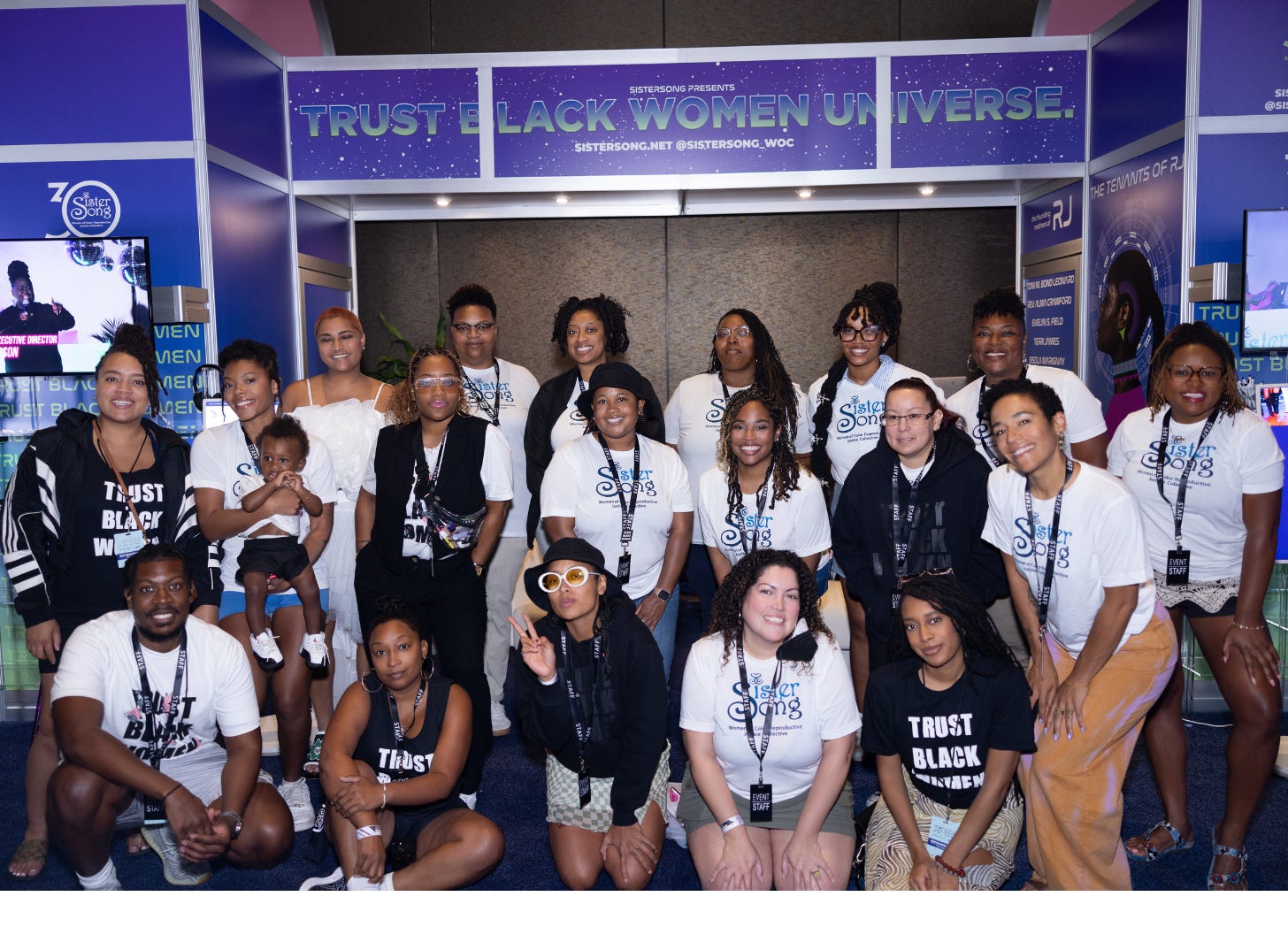
It sounds like story sharing has functioned as a form of mutual support and community care. I’m interested in what that support looks like when you put storytelling at the center, when listening to each other and sharing our stories becomes an act of caring for one another. How does that shift what mutual support looks like for the people who need it?
Dr. Spencer: I don’t know if it’s a change in what mutual support looks like so much as it demands that people see the importance of supporting each other. These are opportunities for people to recognize and reaffirm that the human in me sees the human in you. In an interview in a focus group, you are often looking face-to-face with a person or a group of people, in a circle, talking about what can be really challenging topics.
It brings all of that to the forefront. It asks people to engage with things that they might not always think about or might not always talk about. It puts it in the center of the room and says, “Okay, this is what we’re talking about in this safe space. This is our moment. These are our 45 minutes. This is our hour to start to think about how we might deal with it.” It really changes the way people have the opportunity to engage with these topics and really brings it home for people.
I appreciate the way you wrestled with that. Thank you. I love that you said, “These are opportunities for people to recognize and reaffirm that the human in me sees the human in you.” It seems like we are existing in a moment where we forget that almost. I don’t know if that rings true to either of you, but I am curious because it did just stand out to me.
Simpson: I do think that we have to constantly check in with ourselves on creating balance. Yes, we want to be able to show and understand what our impact is, but we’re not going to overshadow these intentional connections with our people.
What has been really powerful for us, and using the types of models that we do, is that we’ve set ourselves up to constantly be able to bring ourselves back to what is the main thing: How are we building with our people? How are we making sure our people are seeing themselves reflected? How do we make sure that our people are being heard, that their stories are amplified? That is the core, and that is actually the work.
Dr. Spencer: I absolutely agree with that. What has been helpful to me—and what I think serves as such a powerful backstop—is that we are connected to this larger movement. It’s not just the mission and the vision of SisterSong, but everything that we do needs to be held up against the tenets of our day. That, in some ways, makes it harder. But also in a lot of ways makes it easier, when you really engage with that, to determine where the spirit of a piece of work or a relationship is or where it’s going because we have that very clear set north star of where we’re trying to go and how we’re trying to get there.
Now, I want to put Sister Song within the context of a broader history. Black people have always created space for one another to rest, to resist, worship, organize, et cetera. When you think about the lineage of us holding and creating space within our communities, I’m curious what moments or traditions come to mind? And what are some instances of Sister Song carrying that lineage forward?
Simpson: The first thing that comes to mind for me as a very country Black girl is the front porch. I grew up with a front porch, and I was a witness to so many conversations between the elders of my community, my mama, and her friends. I could hear the stories of community care. I heard stories of what they needed to do to take care of their health. Someone would respond with, “I got some of these leaves in the house. I’m going to give you some of these before you leave.” These are the stories that I heard on this porch among people, creating care for each other, helping each other with their health, and making sure that we were all as healthy as we could be, that we were fed, that we were seen, that we were celebrated.
I don’t think many people understand the power of the front porch anymore and all that happens there. But that’s my first understanding of a sacred communal space. And, of course, I also think about the church as another place. But I’m curious to know what comes up for you, Noelle?
Dr. Spencer: This is such an interesting question; I was trying to write down my thoughts to parse it out. What first came to mind for me were family reunions, especially growing up, and that feels like such a direct comparison to some of our larger SisterSong convenings—both the ones that we host and the ones that we support.
What came to mind second was celebration that is both quiet and loud. In my family and in how the Black community celebrates, especially younger folks, you have a quiet celebration of accomplishments. Because, especially for Black women, at least in my upbringing, there was an expectation that you would do well. So people weren’t always shouting your wins from the rooftops necessarily.
Then there’s the loud. I noticed even in small ways, after I got my doctorate, coming into reproductive justice spaces, people will say, “doctor this and doctor that” in a way that is such a kind and celebratory recognition of your accomplishments. It’s not about being different or better than anyone else. It’s about saying, “I see you, and I see what is important to you.” Also, just in reflection of my time being part of SisterSong, there are some interesting connections to [my own upbringing] that hadn’t come up in other places that I’ve worked. This is the first place where it has been much more focused on the Black experience.
Simpson: I appreciate that. SisterSong has worked to recreate these types of sacred spaces that are a part of our history as Black people. I think about the round tables that we created, whether it’s bringing Southern leaders together in a room this year or reconvening all the Black leaders of the reproductive justice movement 10 years ago. I was looking back at those pictures and seeing the intergenerational footprint in the room. It was inspiring to see the healers, practitioners, strategists, and policy folks all together in one room. People didn’t have their shoes on. People was wrapped up with each other in their scarves. We don’t do these convenings in a very structured way all of the time. Yes, there’s an agenda, and we want to ensure that we meet the flow, but we also create enough spaciousness for people to simply be in space with one another.
The feedback that we get is that this didn’t feel like a conference; it felt like a transformative experience.
The four mini communities were Indigenous Americans, Black Americans, Latina Americans, and Asian Americans.
Dr. Spencer has been at the organization for just over two years.