

Michele Thorne on Food Sovereignty, Black Farming, and the Fight for Ethical Protein
The executive director of The Good Meat Project discusses the legacy of Fannie Lou Hamer, the barriers facing Black livestock farmers, and what cooperation and community could make possible.

Food has always been a site of both self-sufficiency and liberation for Black communities. From the enslaved Africans who cultivated a knowledge of soil and seasons under impossible conditions to Fannie Lou Hamer’s Freedom Farm Cooperative, the ability to grow, raise, and distribute food has been inseparable from the fight for self-determination. That history is not a relic. It is a living current that runs directly through the work of Michele Thorne.
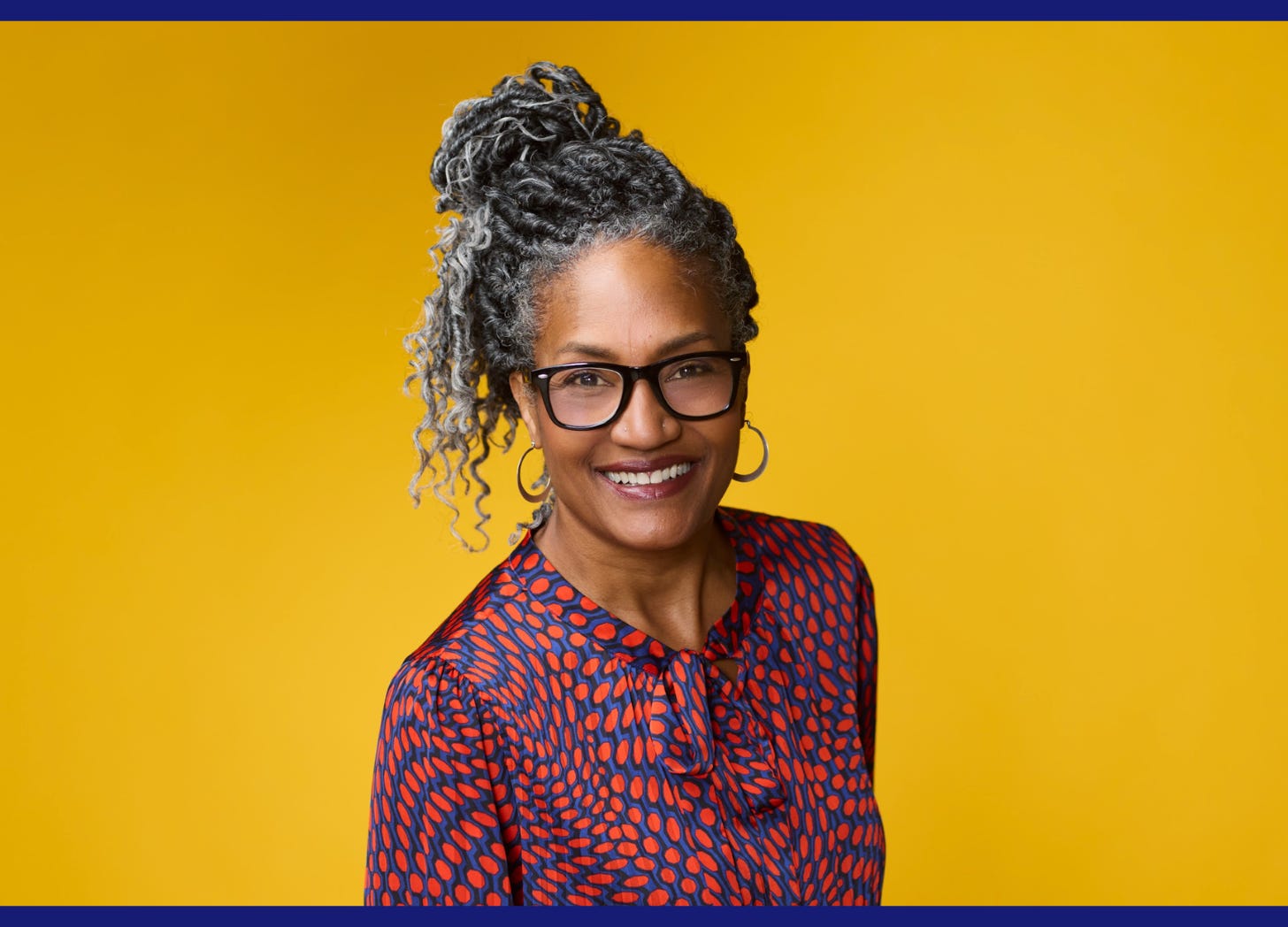
Thorne is the executive director of The Good Meat Project, a national nonprofit that connects consumers, farmers, and food professionals across the meat value chain through education, resources, and advocacy for transparency. Her path to this role was anything but linear. She started her career as a graphic designer in New York, then moved through food education, professional cooking, raw food advocacy, podcasting, livestock farming, and an MBA in sustainable business—all propelled by a fundamental question about where food comes from and who benefits from its production.
That question first took root in Brooklyn and Harlem, where Thorne saw the health consequences of a food system that wasn’t designed with her community in mind. It led her to raise 100s of chickens, ducks, turkeys, and pigs on rented land in Oregon as a first-time farmer, and to confront firsthand the capital and land access barriers that keep Black farmers—especially Black women—from bringing meat to market.
Our conversation, edited for length and clarity, ranged from the legacy of Fannie Lou Hamer to the structural barriers facing farmers of color, the corporate influences on the meat industry, and what it would take to build a food system rooted in cooperation and cultural preservation.
Julia Craven: I’m starting with the question I ask everyone I interview: What does a healthy future look like to you?
Michele Thorne: I think about this a lot, and I want to put “healthy” in quotations because healthy can be relative to different people. To me, healthy can show up in a lot of ways when we’re talking about food. Healthy sounds like nutrient density. It looks like the food that I have access to and choose to consume.
I’m a little bit unconventional. I do what I can to walk the walk. I purchase a whole cow from a local farmer every year. That’s my commitment economically to the community I live in. It’s an investment in my health—nutrient density and transparency into the meat that I buy. I know it’s one animal. I’m not getting 100 animals in my ground meat, as you would from the grocery store.
I’ve gotten to this point in my life where I know what works for me. But a healthy future at large? That’s harder. My hope is that we reinstate critical thinking and that we slow down. I think we have a real opportunity to have a Sankofa moment1, to look back at history, at how our ancestors ate, how they grew food, how they weren’t burdened with the nutrient deficiency in food that we are facing now.
The reason the United States has been an agricultural powerhouse is that we had bison on the plains that, over the decades, created fertile soil. We had that trifecta of man, animal, and land. That’s an unbreakable bond that corporations and this culture of convenience have been—and are still in the process of—destroying.
In economics, there’s a thing called the tragedy of the commons. We all share water, for example, and air. And if we allow bad actors to poison the well, we all suffer. Food is one of our greatest dependencies because it’s the only thing that we actively choose to put into our bodies every day. You would think we would not turn such a blind eye to our food and be so detached from its production. But in this culture of convenience, this culture of hustle, the price we’re paying really is an externalized cost that we have to pay in the future—and we’re starting to see that chicken come home to roost.
I appreciate how you brought all of these moving parts together in your answer. Now, for anyone who hasn’t followed your journey, how would you describe what you do?
I embrace transparency, especially in food. I have pursued this career and these parts of my life around food because I want to see a transparent food supply chain for myself, for the people I love, for my community, and for the stakeholders we serve at The Good Meat Project. That’s really a foundational principle in my work. Everything else flows from that.
You’ve worked across the food value chain from ranch to fork. How has that broad experience shaped the way you lead the Good Meat Project today?
For a really long time in my career, it was very difficult to understand how the things I pursued connected to each other. I started right out of college as a graphic designer. I owned my own studio in New York. At some point, shortly after college, I started investigating how food impacted health outcomes. I saw the impact of food directly in front of me —in my community, living in Brooklyn and Harlem—and in my family. So I became a voracious reader and researcher, wanting to understand why food had the impact it did on human health.
That led me down a circuitous path. I became an educator in Brooklyn, teaching cooking and healthy eating in small pockets of the community. From there, I became a chef at a vegan biodynamic wine bar in New York, which was a unique and creative place to experiment with food and ingredients. But at some point, I began asking: Why am I eating food that has grown thousands of miles from where I live? It didn’t square with me that I was sourcing coconuts, for example, from Thailand, where I didn’t have any transparency into how they were harvested, how they were grown, the workforce that may or may not be treated fairly or paid fairly, or the ecological footprint of getting them to New York City.
That led me to food production. The people who owned the restaurant where I worked actually had a rooftop garden, and that was my first foray into having a hand in growing food. I wrote a book about raw food and healthy eating, and created a podcast with almost 100 episodes on everything from avocados to baby food to makeup. And then, through a job with a nonprofit working with pastured meat producers, I inherited a flock of chickens and a flock of ducks. Understanding the roles that livestock and soil health play in food production, it was fascinating to have my hands in it as a first-time farmer. I wound up raising hundreds of chickens, ducks, turkeys, quail, rabbits, and pigs for food production. It takes so much grit and so much work.
It wasn’t until right before I came into this role that I really understood how to weave together the fabric of marketing, graphic design, food production, food systems, leadership, and my MBA in sustainable business. I had no idea how it would all connect, and then it did.
Your work sits at an interesting intersection. Food, public health, economic resilience, environmental stewardship, and community care. What role, if any, do history, lineage, and ancestry play in your work?
It has definitely played a role, but it isn’t something that is forward-facing. It’s embedded more silently. It’s a thread that is inspirational to me. Since we are a national nonprofit and do our best to be inclusive, I don’t lead with affinity groups. I’d rather highlight the people and professionals in the meat value chain accordingly. I am a Black woman in this role, so I like to feature the women butchers, the Black butchers—like Norm of Black Butchers United, who is doing incredible work—and our connections to the LGBTQIA+ community doing this work. Featuring them in our snapshots, in our journal, in all the things that we do is a priority.
In my own family, my mother was born in Harlem. My father was born in Trinidad and immigrated here in the 1960s. I didn’t really get the historical knowledge base from my own family. I only learned later in life through my uncles and aunts about what was happening in Trinidad and how they had links to farming and agriculture for survival.
When I made the choice to become a livestock farmer, I was also inspired by the work of Fannie Lou Hamer and Letitia Carson.
Letitia Carson2 was one of the first, if not the first, Black female landowners in Oregon. What Fannie Lou Hamer3 did in her time is remarkable. That’s why I got pigs. The way she was able to feed her community through this almost piggy bank system—she had pigs, and the pigs would have babies, and she would give a pig to someone to raise. Her only payment was that she’d get a piglet back.
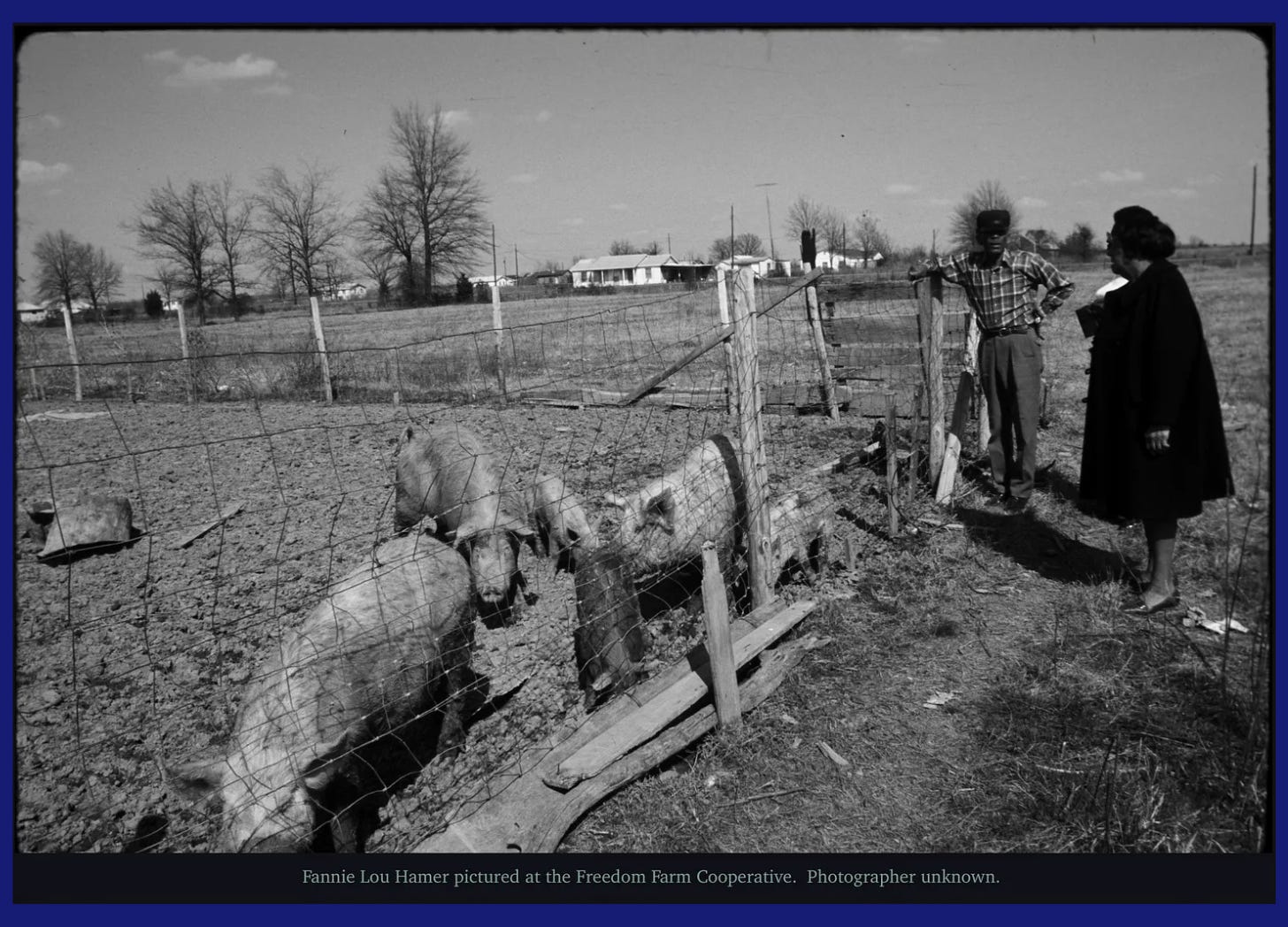
Yeah, the Freedom Farm Cooperative.
I mean, unbelievable. Why aren’t we doing that? I know why we’re not doing it: the biggest barrier to raising protein for humans is land access. It’s huge. It’s not just limited to people of color at this point. It’s really everybody because of the economic infiltration of land ownership by corporate investors.
As we know, especially through the work of Fannie Lou Hamer, resilience is having access to land and being able to produce your own food. In the Black diaspora, having links to agricultural production is essential. That’s essentially where the saying “40 acres and a mule” came from.4
What changes in policy, infrastructure, or investment would most improve the livelihoods of Black farmers and other farmers of color?
Capital is a big one. There are many organizations that can provide business education, marketing support, and help getting into wholesale or retail distribution channels. For a couple of years, I taught beginning marketers in the Chicago area through the Windy City Harvest program, which hosts a bunch of young, enthusiastic farmers of color trying to grow food for their communities. But the barrier was not necessarily education.
Some of the hurdles are related to policy, especially on the meat production side. There are a lot of hoops you have to jump through to get meat to market, and the capital investment in meat production is much higher than in fruit and veg.
One of my dreams as executive director is to attract landowners to donate land to The Good Meat Project so we can start an incubator farm in several regions where young people can start learning about livestock production and have access to land. I want them to have a first-hand understanding of grazing, rotation, animal science, animal health, meat processing, and meat distribution. All of those things make it possible to level the playing field.
I really wanted to be one of those people bringing meat to market as a Black female producer. I wanted it so badly when I started. I was old by the time I started—in my late 40s—but I wanted it so much. I loved it. I understood why it was important. And even as a mature professional with an MBA who understood spreadsheets and could talk my way into boardrooms, it was still very difficult to have access to capital. I still haven’t done it. I don’t own land. I can’t do what I love, so I have a full-time job now that pays the bills. I’m not farming very much anymore, even though I still have livestock for my own family.
It’s a multifaceted initiative, and I think the way forward is collaboration, not necessarily with organizations that do the same thing, but with like-minded organizations. I could see The Good Meat Project collaborating with funders for regenerative agriculture and working with land trust organizations to secure 10 or 20 acres in five regions across the United States for co-op- or incubator-style meat production. A lot of people have proven this concept already, especially with fruit and veg, where resources are aggregated, including equipment, space, and paying into the business structure as a collective, so it doesn’t all fall on one person.
I also think the marketing and messaging around local meat needs to shift. Right now, there’s a lot of push marketing, which is the farm saying, “We’re over here, come buy our meat.” The reverse needs to happen. We need to pull consumers in by educating them about the benefits —not just the features —of local meat production: how the money stays in the local economy instead of going offshore; how supporting small pasture-based farms is better for the environment, the water table, the air, and the soil quality; and how that creates resilience, especially when the supply chain breaks down, as we saw during COVID.
And there are cultural foodways impacted by meat production. Halal demand for goat meat in certain communities, for example, or collard green varieties with historic roots in Southern communities. Specific varieties of corn in Indigenous, tribal, and Latino communities. These are important to preserve, to make sure they’re not extractive, that they don’t die because of corporate seed patenting, and that we can continue having them for generations to come.
I want to end on a practical note. What resources does The Good Meat Project have for the average person who wants to connect with better meat?
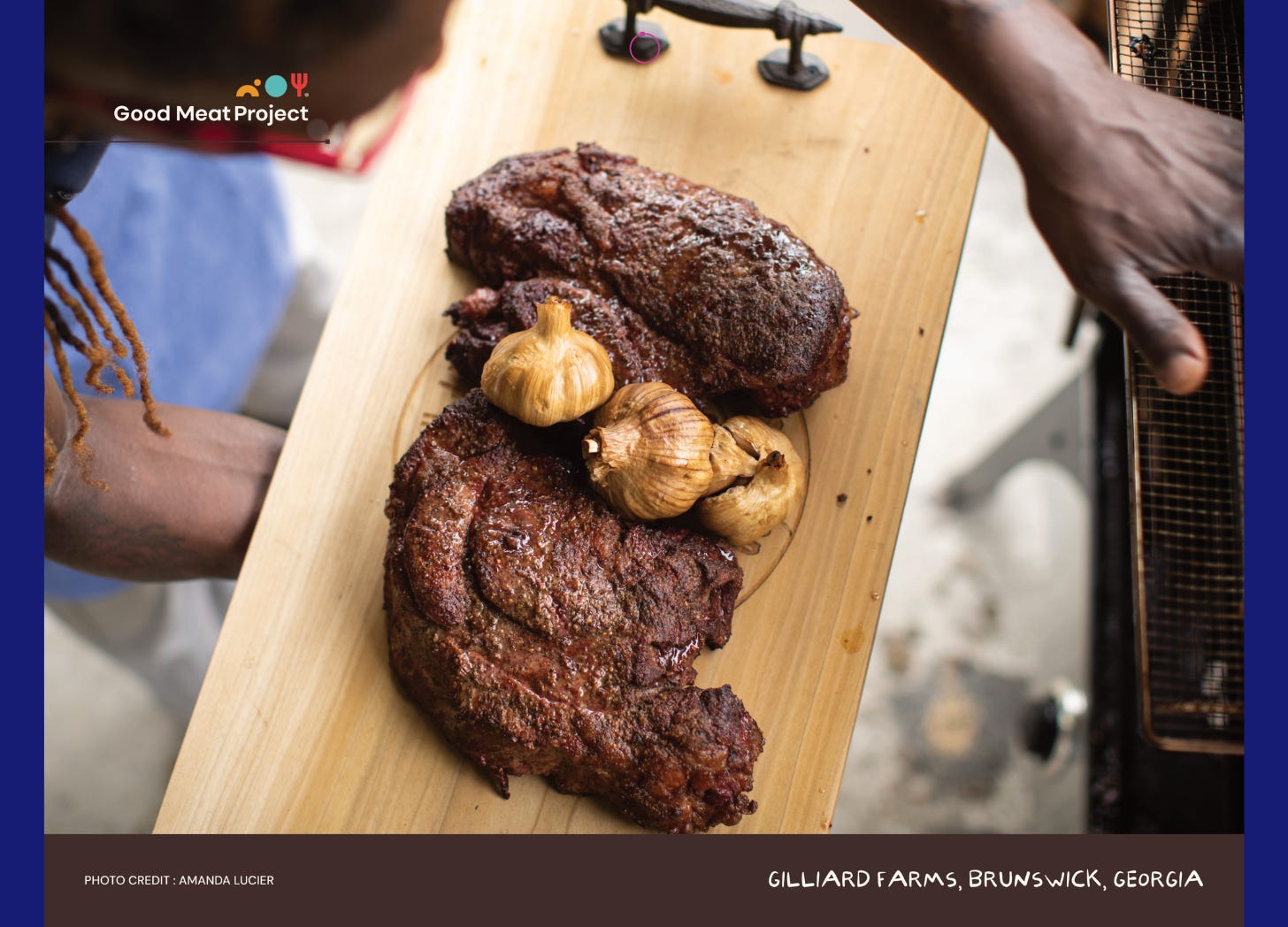
We have the Good Meat Finder, which is growing as a way for consumers to have agency over the meat they choose to buy. If you want to support a producer of color, you can go to our Finder and see if there’s one near you selling. If you want to support a woman-owned business, a veteran-owned business, or look for grass-fed—whatever your values are, you can filter for that. We also list restaurants, retailers, and butcher shops, not just farms. And we have consumer resources on our Good Meat Breakdown to help people find, buy, and cook meat.
The Breakdown is good for anyone confused about investing in a good cut of meat, say, for a holiday or special occasion. We’ve got resources that help you understand how to cook tough or tender meats, and which cut is the most economical yet still a good value with great flavor. We even have a blog post on the most underrated cut in the butcher case.
What is the most underrated cut in the butcher case?
Sirloin. Hands down. It is amazing. It’s affordable, nutrient-dense, flavorful, and one of the easiest cuts to cook. Where the sirloin lives on the carcass is right next to the tenderloin, which is one of the most tender cuts, and right before the rump, which is one of the toughest. So, depending on which part of the sirloin you’re getting, you could get something really tender.
When you look at Brazil, for example, their most favored cut is the picanha, the sirloin cap, because that’s where the fat and the flavor are. If you’ve never had picanha, go to your local butcher and ask for it. It will change your life.
Sankofa is a concept that roughly translates to “go back and fetch it,” emphasizing the importance of learning from the past to move forward. Thorne uses it here to describe the value of returning to ancestral food practices.
Letitia Carson (c. 1822–1888) was one of the first Black women to own land in Oregon. Read more about her.
The Freedom Farm Cooperative was founded by Fannie Lou Hamer in 1969 in Sunflower County, Mississippi. Read more about it in Healthy Futures.
“Forty acres and a mule” refers to a post-Civil War promise made through Special Field Orders No. 15 in January 1865, which set aside confiscated Confederate land for formerly enslaved people. The order was reversed by President Andrew Johnson later that year, and the land was returned to its former owners. The broken promise became a symbol of the federal government’s choice to not provide Black Americans with the economic foundation needed for true freedom—a failure whose consequences, including the massive loss of Black-owned farmland over the following century, persist today.