

Well-Spent #2: A Cashmere Brand Made Creatine. I Tried It.
Quince sells clothing, bedding, and now supplements. Here’s what they get right and where they could improve.

Quince sent me these products to test and, as always, any assessment of them is my own. This post has also been updated with affiliate links, which earn me a small commission if you buy through them.
Welcome back to Well-Spent, the series where I test health and wellness products and tell you whether they’re worth the hype. If you missed the first edition, I reviewed Prequel Skin. Go check it out.
This time, I’m testing three products from one brand across two completely different categories. Quince sent me a pair of training leggings, a whey protein isolate, and a creatine monohydrate. If that sounds like a wide range for one company, that’s because it is. Quince started as a direct-to-consumer brand selling cashmere sweaters and linen bedding. Now they sell supplements, which I have a lot of thoughts about, which I’ll share at the end.
Let’s get into it.
About the Brand
Quince is a direct-to-consumer company that positions itself as “luxury essentials, honestly priced.” Their model cuts out the intermediaries—like wholesalers and retail storefronts—and they publish a transparent cost breakdown on every product page showing exactly what goes into determining the price. They sell across several retail categories: cashmere, activewear, home goods, travel essentials, jewelry, and now wellness products such as vitamins and supplements.
The brand’s appeal is clear. If you’ve ever wanted the quality of Lululemon or Thorne without the markup, Quince is marketing directly to you. Their audience is the consumer who shops with intention, who reads reviews, compares price-per-serving, and doesn’t want to overpay to show off a luxury label.
Green flags: Price transparency on every product, 365-day return policy, WRAP-certified factories for apparel, and cGMP-compliant/FDA-registered facilities for supplements.
Yellow flags: The company’s range of categories—from bedding to protein powder—raises a question worth sitting with: Is Quince a company that does many things well, or a company that does many things to appeal to as many people as possible?
About the Reviewer
I’m a health journalist, a lifter, and a consistent wellness consumer. I’ve been strength training consistently for seven years, taking creatine for several of those, and I have opinions about leggings that some might call unreasonable, but I call informed. I’ve tried pretty much every activewear brand on the market. Lululemon, Nike, Under Armour, Alo, Oner Active, Gymshark, Fabletics, Outdoor Voices, Girlfriend Collective, and several Amazon, Target, and Walmart options—you name it, I’ve probably purchased it. The same goes for protein powder. If it’s for sale, it’s probably been in my cabinet at some point.
I’ve been testing these three products for six weeks.
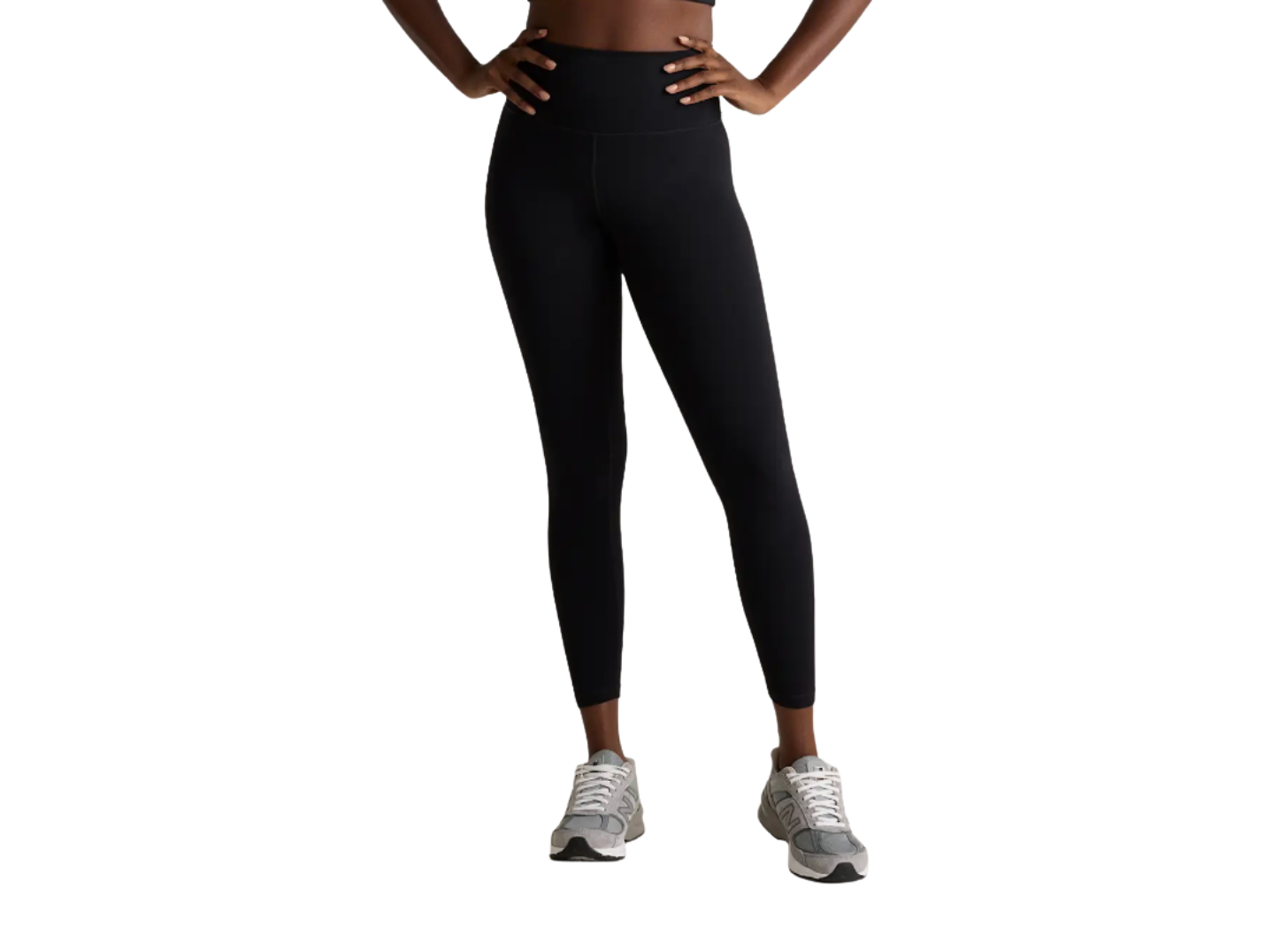
Product 1: Power-Up High-Rise Training Legging
$44.90 · Sizes XS–XL · 25” and 28” inseam · 77% recycled nylon, 23% spandex
Quince markets these as high-intensity training leggings designed for weight lifting, HIIT, and other training-style workouts like plyometrics. They claim medium-level compression, moisture-wicking, antimicrobial properties, 4-way stretch, and cooling technology. At $44.90, they’re positioned at roughly half the price of comparable Lululemon and Outdoor Voices leggings ($98) and well under Alo ($128).
What I Found
These are comfortable, well-constructed leggings that I genuinely enjoy wearing. I wore them running—which, for the record, Quince doesn’t market them for—and they were excellent. They stuck to me like glue and didn’t slide down once, which is a harder bar to clear than most people realize. The fabric feels buttery and soft, more like Lululemon’s discontinued Full-On Luon than a true high-compression training fabric like Under Armour’s. That’s where the marketing starts to stretch further than the leggings.
The “medium-level compression” claim doesn’t hold up. These do not compress. They’re comfortable and move beautifully, but if you’re looking for the kind of compression that supports heavy lifting or plyometric-style training, you won’t find it here. These are yoga, Pilates, and loungewear leggings. I also didn’t notice the “cooling technology” during my workouts. The leggings performed well at moisture-wicking, however.
Now, the drawcord. The interior adjustable waistband drawcord snapped completely when I gave it a single tug to unknot it. It didn’t just fray. It came apart. That’s a construction failure worth noting since many women rely on it to mitigate the finicky fit of most leggings—especially if you have a pear or hourglass shape.
On the bright side: after six to seven washes with air drying, the leggings have held up perfectly. No pilling, no fading, no stretching out, and fully opaque. The fabric’s durability is excellent.
Sizing & Fit
I ordered an XL, as I typically do with leggings marketed as compressive, since I have big hips and a larger backside, and they ran large on me. I should have sized down to an L.
The size range (XS–XL) is not size-inclusive, and my experience suggests the sizing runs a little big due to the fabric’s stretch, contradicting multiple reviews that say they run true to size. Your mileage may vary, but I’d recommend sizing down if you’re between sizes.
The Research
The leggings’ recycled nylon/spandex blend is a legitimate performance fabric, and recycled nylon is a sustainability improvement over virgin materials. The WRAP certification at their factory in Vietnam is a credible, ethical manufacturing standard. The “anti-microbial” claims are difficult to verify without knowing the specific treatment applied to the fabric, and Quince doesn’t disclose that. Besides, you should be washing your leggings regularly anyway. That’s more important than whether they’re antimicrobial.
Who This Serves (And Who It Doesn’t)
Serves: Someone looking for a comfortable, well-made everyday legging at a fair price. A yoga or Pilates person who wants something soft and durable. Anyone who doesn’t need compression but wants a legging that stays put—which, for the record, is a very cool feature for leggings to have.
Doesn’t serve: Lifters or HIIT athletes who need compression. Anyone above an XL. Anyone relying on the drawcord to stay secure.
The Verdict
It depends. Worth it at $45 as an everyday legging for yoga, Pilates, and running around. Not worth it if you’re buying them for the training and compression claims on the label. They also flare a little bit at the bottom, which I personally dislike since I prefer a seamless look when wearing leggings. The drawcord failure is a red flag for quality control, but the fabric itself is durable and comfortable.

Product 2: Grass-Fed Whey Protein Isolate
$45 for 30 servings ($1.50/serving) · Vanilla Bean and Chocolate · 25g protein per serving · 1g sugar
What They Say
Quince calls this “pure, powerful, and performance-driven.” It’s a grass-fed whey protein isolate with 25g of protein per serving, a digestive enzyme complex, no artificial flavors, no stevia, and no sugar alcohols. They claim it’s third-party tested, free from hormones, antibiotics, and GMOs, and produced in an NSF cGMP-compliant facility. At $1.50 per serving, they position against Clean Simple Eats ($2.17/serving) and Thorne ($2.17/serving).
What I Found
This is a great protein powder. The Vanilla Bean smells like a Rice Krispies treat—sweet but not cloying—and has a smooth, clean flavor with no aftertaste or grit. The Chocolate is more standard, but it blends up beautifully into a protein hot chocolate. Both mix well into oatmeal, cold drinks, and smoothies without clumping or leaving that chalky residue that makes you question why you didn’t just wash out the nonstick pan you cook eggs in and make some.
What surprised me most was the lack of side effects. Whey isolate usually triggers breakouts and mild stomach issues for me, even when it’s labeled lactose-free. This one didn’t. I can’t say exactly why. It may be the digestive enzyme complex (papain and bromelain from papaya and pineapple, respectively), it may be the formulation, or it may just be my body cooperating for once, but it’s notable.
I also appreciate that the nutritional profile includes minerals without veering into “let’s also make this a multivitamin” territory like ISOPURE Essentials. Plus, those other brands charge $10 to $20 more per container. At $1.50 per serving, the value is substantial.
It’s my new fave.
The Science
On “grass-fed”: “Grass-fed” on a whey isolate is more marketing than science. Grass-fed dairy does have documented nutritional advantages over conventional dairy. It has more omega-3 fatty acids, conjugated linoleic acid (CLA), and fat-soluble vitamins, but those benefits live primarily in the fat. Whey protein isolate is processed specifically to remove fat. So the compounds that make grass-fed dairy nutritionally superior are largely removed during processing. A 2024 randomized controlled trial found no significant difference in muscle recovery between grass-fed and conventional whey protein. BarBend published a good piece breaking this down.
On third-party testing: Quince says this product is third-party tested and produced in an NSF cGMP-compliant, FDA-registered facility. We love to see it! But it’s the manufacturing facility that’s cGMP-compliant. The product itself does not publicly carry a seal from a reputable third-party tester.
Why does this matter?
Let’s take a step off to the side, and I’ll explain. Receiving third-party verification from recognized, independent organizations like NSF International, U.S. Pharmacopeia (USP), Consumer Lab, Informed-Choice, or the Banned Substances Control Group (BSCG) involves independent lab testing of the actual finished product for contaminants, label accuracy, and purity. The dietary supplement industry in the United States is not required to get FDA approval before selling products. Third-party testing results are one of the few—if not the only—mechanisms consumers have for verifying that what’s on the label is actually in the product and that nothing harmful is in there alongside it.
I’m not saying that Quince doesn’t third-party test. I am saying not naming the third party or making the results publicly available means the consumer cannot independently verify the claim, and that will always raise my eyebrow.
On protein powder in general: Food will always be the best option for meeting your protein needs. No one needs protein powder. This is a convenience product, and the wellness industry has done a remarkable job convincing people it’s a necessity.
Who This Serves (And Who It Doesn’t)
Serves: People who want a well-priced protein powder. Lifters and active people who need a convenient protein source. People with sensitive stomachs who’ve had trouble with other whey isolates.
Doesn’t serve: Anyone who can meet their protein needs through food (which is most people). People looking for plant-based protein. Anyone who specifically needs NSF Certified for Sport products, such as competitive athletes subject to drug testing.
The Verdict
Worth it. I love this protein powder real bad. Genuinely good taste, smooth mixability, no digestive issues, and a nutritional profile that outperforms its price point. Transparency around third-party testing is needed, but the product itself delivers.
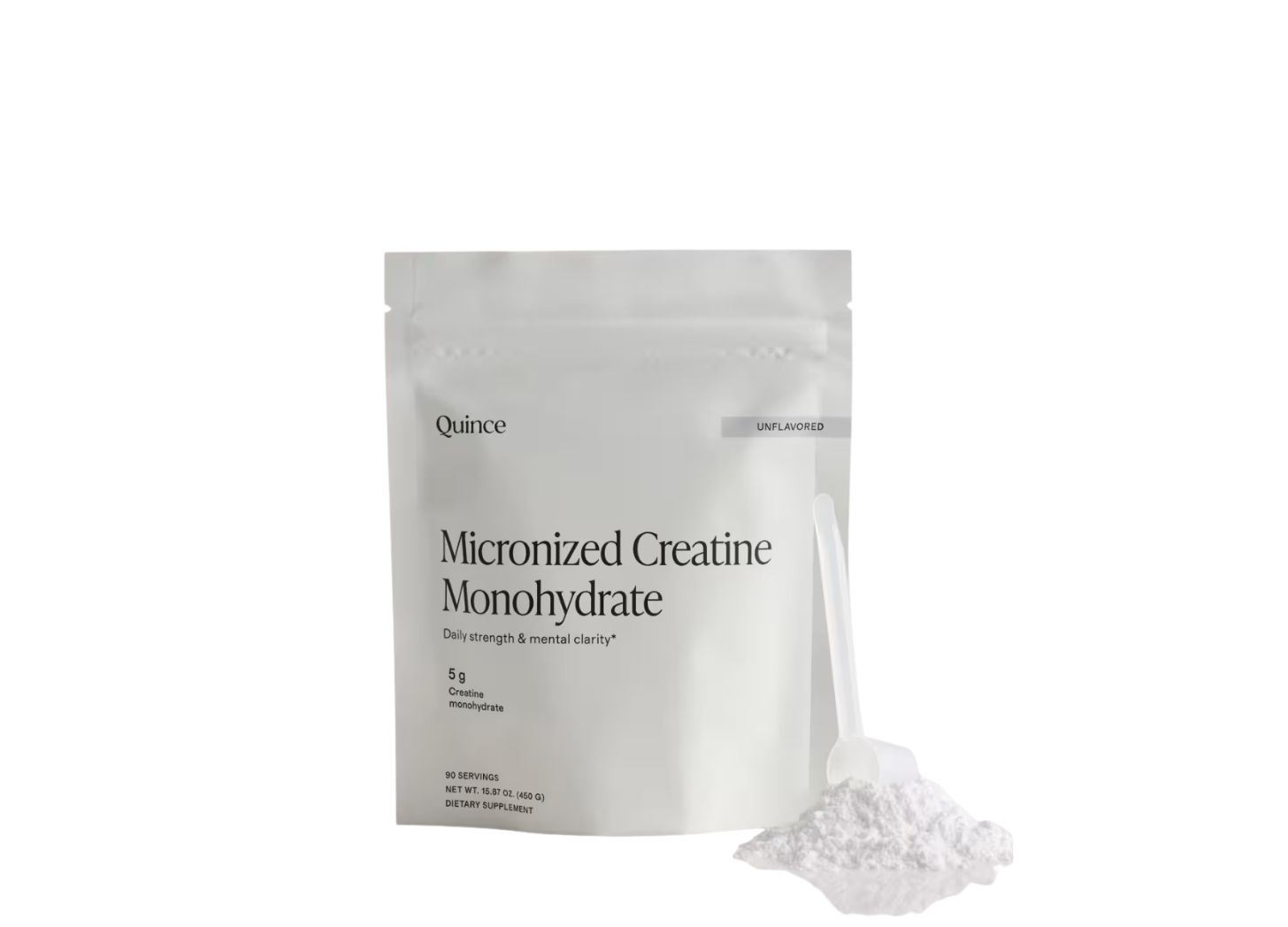
Product 3: Micronized Creatine Monohydrate
$20 for 90 servings ($0.23/serving) · Unflavored · 5g per serving · Vegan
What They Say
Quince describes this as “one ingredient, unlimited potential.” A great tagline, indeed. This is a pure, micronized creatine monohydrate engineered for “superior absorption” to support strength, lean muscle, recovery, and cognitive performance. They claim it’s third-party tested and free of the top 12 major allergens. At $0.23 per serving, they significantly undercut Momentous ($0.44), Thorne ($0.48), and Transparent Labs ($1.67).
What I Found
I’ve been taking creatine monohydrate consistently for years. What stood out immediately is that this creatine has no weird aftertaste, which is unusual. It’s very light and powdery. It dissolves completely, leaving nothing behind in the cup of tea I mix it into every morning. My previous creatine (Naked Nutrition) always left a gritty residue at the bottom. That’s a small thing that makes a real difference in adherence, since it provides a better user experience.
Creatine is known for improving strength and fitness capabilities by increasing muscle mass, but I can’t attribute my gains to a supplement after seven years of consistent cross-training. Maybe that’s my ego, but I don’t care. What I can say is that I feel cognitively sharper on days I take creatine versus days I don’t, which is consistent with the research.
The Science on Creatine
Speaking of, creatine monohydrate is the most researched sports supplement. The International Society of Sports Nutrition’s position stand is unambiguous: it is the most effective ergogenic nutritional supplement available for increasing exercise capacity and lean body mass. Creatine is the subject of more than 500 peer-reviewed studies and has been shown to benefit everything from strength and recovery to short-term memory and cognitive reasoning.
The important thing to understand about creatine is that the form is the product. Creatine monohydrate is creatine monohydrate. The molecular structure doesn’t change because the label is prettier. What varies between brands is purity, micronization (which improves solubility and, in turn, bioavailability), and whether it’s been independently tested for contaminants. At 5g per serving and no additional ingredients, Quince is giving you exactly what the research supports.
On third-party testing: Again, Quince claims this product is third-party tested, but the brand doesn’t name the lab conducting the testing. I always push for named, recognized certification bodies when it comes to supplements, and the absence of that information is worth noting.
Who This Serves (And Who It Doesn’t)
Serves: Anyone interested in creatine who wants a well-priced product that dissolves properly.
Doesn’t serve: Competitive athletes who need NSF Certified for Sport verification. Anyone new to creatine who hasn’t consulted their doctor—start there.
The Verdict
Worth it. The product itself is excellent, and the price point is fantastic. But the lack of a named third-party certification is an annoying gap.

Final Thoughts
Quince is a fashion and home goods company that decided to sell you supplements, too. That is a specific kind of expansion that occurs when direct-to-consumer brands realize that wellness is the highest-margin, fastest-growing consumer category and that the supplement industry has virtually no regulatory barriers to entry.
I don’t think Quince is selling snake oil, but the several lapses in transparency noted above give me pause. I’m a stickler about clarity when it comes to what we put in our bodies. For a company that sells itself on transparency, that gap is certainly something to keep in mind when you’re considering purchasing their wellness products.
Well-Spent publishes on the last Friday of every month. Have a product you want me to test? Drop it in the comments.
I love all your writing. It would be great (for me) if you offered a way to tip you/buy you a coffee/etc. With my current income I'm avoiding signing up for subscriptions.